









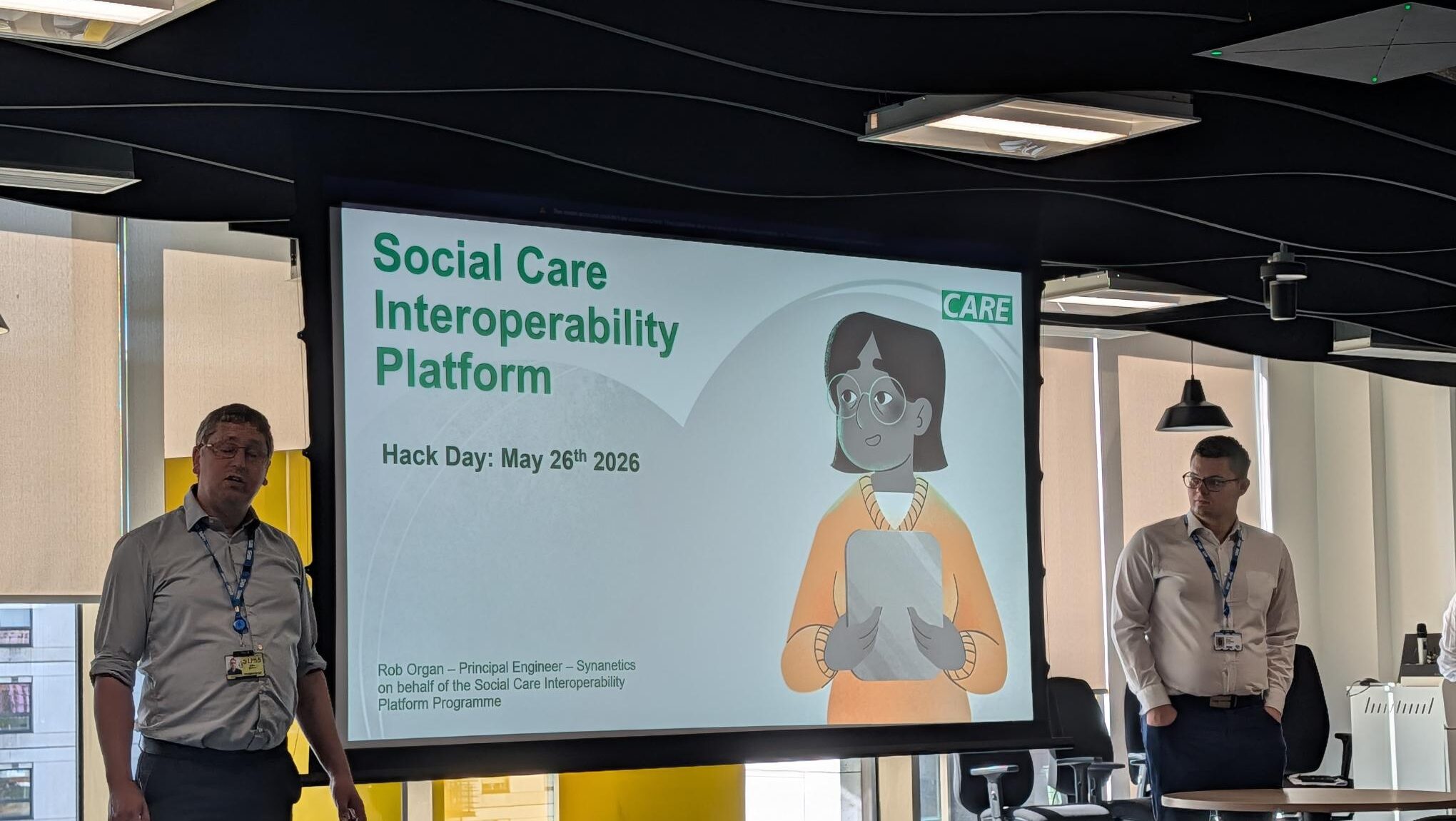
On Tuesday, May 26th, our Chief Technology Officer Jamie Hibbard attended the Social Care Interoperability Platform Hackathon hosted by Digitising Social Care. Below he shares his experience and takeaways from the day.
Yesterday our CTO Jamie Hibbard had the opportunity to spend time at the NHS England office to discuss interoperability across health and social care.
As a digital care platform, we see every day how important connected data is. At Nourish, we have invested heavily in our integrations hub and we are leading the sector in helping care providers connect systems, reduce duplication and make better use of the information they already hold.
But connection into the NHS and shared care records has been slower than it should be. It has also, at times, been a real frustration
Despite best intentions the complexity of the landscape remains a challenge
Each trust, region and shared care record can have different technology providers, standards, pathways and governance requirements. Even where the goal is the same, the route to get there is often different.
At Nourish, we are fortunate to have successfully connected with several shared care records, but maintaining each individual connection is hard, time consuming and expensive.
And if that is true for an organisation of our scale, it raises an important question.
What does this mean for smaller providers who also need to be part of the wider care ecosystem?
In many ways, social care is already far ahead. It had to be more agile, more responsive and more willing to adopt technology because the pressures on the sector are immediate and constant. Care providers are capturing rich, timely information every day, often much closer to the person than any other part of the system.
That necessity is why this interoperability matters so much in social care.
Championing a single point of interoperability is not a new idea for us. It is something we have been talking about at Nourish for the last eight years. We know from first-hand experience how a lack of interoperability creates unnecessary barriers between health and social care.
For too long, providers have had to build and maintain multiple routes into different parts of the system. Each one comes with its own standards, governance, pathways and cost. That slows progress down, limits participation and makes it harder for social care to play its full role in the wider care ecosystem.
That is why the conversation around the Social Care Interoperability Platform (SCIP) feels so important.
The idea of a centralised point of connection for providers like Nourish has the potential to make a real difference. As both a way to read information from the NHS, and critically, as a way to write information back.
The benefits of social care interoperability
Understanding is a two-way street. Across the Nourish platform, around 20 million data points are recorded every day. These are not just numbers in a system. They represent observations, care interactions, risks, changes in condition, outcomes and moments that could help build a fuller picture of someone’s care.
If that information can flow safely and appropriately into wider health and care pathways, the potential is significant.

We could help prevent issues earlier, give clinicians and care teams better context and reduce duplication. All in service of a person’s lived experience of health and care as we create continuity across settings through joined up services.
For interoperability to work properly, social care cannot just be a passive recipient of NHS data. Social care generates vital insight every day, often from the people closest to the person receiving support. That insight needs a route back into the wider system to achieve maximum impact.
This is where a single, scalable point of interoperability could change the direction of travel and transform lives.
Currently every provider having to navigate a different route for every shared care record. The ambition should be to connect once, meet a common standard and allow information to move safely between the people and organisations involved in someone’s care.
Social Care Interoperability Platform Hackathon
This is not just theoretical.
By the end of day one of the hackathon, we were already able to read and write “About Me” and person support profile data between the providers in the room. These are part of the NHS Minimum Operational Data Standards (MODS) framework. The MODS framework is the new standard for helping structure and share key information in a consistent way.
That is a powerful proof point. It shows that when the right people come together around a common goal, and when we align around a shared standard, real progress can happen quickly. This kind of momentum matters. It moves the conversation from aspiration to practical delivery.
The benefits are clear. A single point of interoperability would reduce cost and reduce friction. Unlocking participation for providers of all sizes through their existing workflows. Which means the system could focus more energy on outcomes rather than integration mechanics.
Looking to the future
The hackathon felt like a positive and important conversation. There is still a lot to work through, particularly around standards, governance, supplier participation and making this practical at scale. But it felt like the right people were in the room, asking the right questions.
The opportunity now is to move from good intent to scalable delivery.
Because if we want a truly connected health and social care system, social care needs more than access. It needs a voice, a route in and a way to contribute the insight it holds every day.
SCIP, built around shared standards such as MODS, is an important step towards that future.