










AI can help care teams work more consistently and spot risk earlier. However, social care is a deeply personal service that is both context-heavy and filled with risk. Which means we need strong governance and clear guardrails for AI. The English social care regulator, the Care Quality Commission, recently released their guideline for the safe and effective application of AI in care settings. In this blog we explore how to design AI for social care that exemplifies these standards so it can best elevate the quality of care and support available.
In practice, safe AI is more than just a ‘model’, it’s a product. When we view it as a product, it is easier to make deliberate product decisions for the application of the model. Decisions like, what the AI is for, how it’s presented, and where humans need to stay in control on the output. We must put sensible processes around our reviews. As well as adding automated checks and record‑keeping so we can learn and improve over time.
Start with the full system, not the model
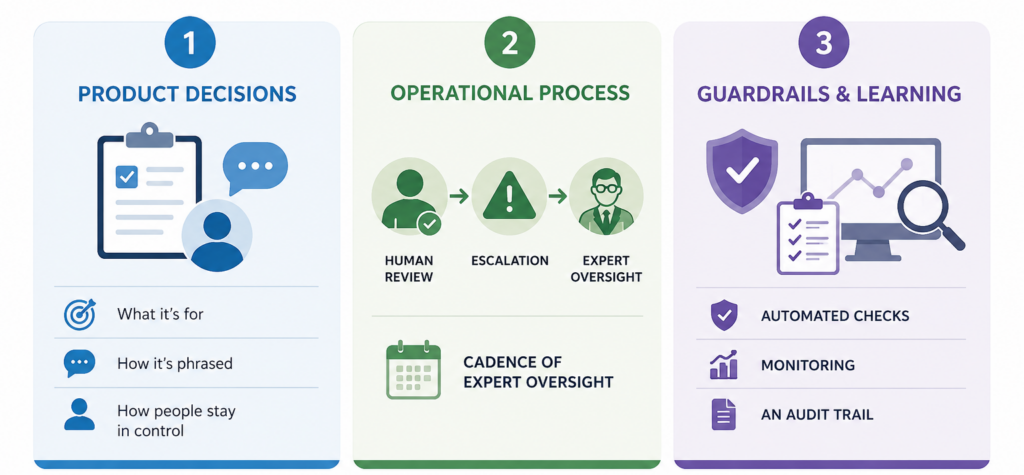
Think of responsible AI as an end to end workflow.
Inputs > AI suggestion > safety checks > human review > learning loop
The details vary by product, but the principles don’t.
Data input: Define boundaries and responsibilities
Start by being clear about boundaries. What information the AI can use, what it must ignore, how up-to-date the inputs are, and who owns data quality. This prevents false confidence and makes issues easier to investigate.
Expert context: Encode clinical intent before inference
Care quality depends on domain knowledge. You should build and maintain clear guidance on ‘what good looks like. This is in terms of terminology, standards and policies. Crucially, with named owners and a review cadence. So the AI stays aligned with your service as practice and policy evolve.
AI analysis: Require evidence, not opinions
Whatever the AI outputs, it should be available to review. Which means showing the relevant source text and including a brief explanation. You want to avoid the logic of ‘because the model says so’. It is vital that the evidence the model utilises is identifiable and interrogatable.

Automated guardrails for AI: Validate before humans see it
AI can be trained to add lightweight automated checks. These are useful for catching the obvious problems before a human sees them. For example, unsupported claims, inconsistencies or repeated items. These checks don’t need to be fancy or overly detailed, however, they do need to be reliable.
- Support check: Is the suggestion grounded in the record?
- Consistency check: Does anything contradict other outputs?
- Noise control: Remove duplicates and low-confidence clutter.
- Policy checks: Enforce a few non-negotiables your organisation cares about, including known issues for AI models like bias, fairness and hallucinations.
Human-in-the-loop: Keep clinical judgement in the driver’s seat
We must keep humans in control. You should design the experience so reviewers can quickly understand the suggestion, accept or reject it, and escalate edge cases. Then use real-world feedback to improve the system on a regular cadence.
The goal is simple, make it easy to do the right thing, and hard to do the wrong thing. The reality is simpler than you’d suspect to achieve.
Responsible AI is also a product problem
There are a number of risks in AI that are well documented. It is important to not, some of the AI risks in social care don’t come from ‘the model’ alone. They come from product decisions like wording, defaults, missing context, and unclear accountability.
It is important that you address these issues with your product teams. Once these basics are set, governance becomes repeatable.
- Be clear about the role of AI
The model suggests, humans decide.
- Design for review
Make sure to show context and make disagreement easy.
- Make uncertainty safe
Include clear escalation paths for high-risk or unclear cases.
- Be transparent
Understand what the model looked at, and what it can’t do.
Governance processes you need and how to operationalise them
Governance is how you earn trust over time, and sets the standard for your guardrails for AI. It is vital to test, monitor, update safely, and keep an audit trail of your actions.
Evaluation: Agree what “good” looks like, then keep testing it!
Before you ship any new features it is crucial you test against a reference set of real cases reviewed by experts. After you ship, keep sampling and checking performance so any drift that occurs doesn’t surprise you. A good way to do this is to define a small set of ‘go/no‑go’ checks for your releases. Be explicit about data handling and access. If you can’t explain those basics, you can’t govern the system.
Change control: Make updates safe (and easy to roll back)
Treat updates like a high-stakes product release. Ensure you are doing everything thoroughly, document changes, getting the right sign-off, and make rollback a straightforward process.
Metadata and auditability: Make every finding explainable
Audit trails are essential aspects of guardrails for AI. You need to keep an audit trail so you can answer important questions and evidence your working. Questions like, ‘What did the AI see?’ ‘What did it suggest?’ and ‘What did the human decide?’.
- Inputs: What record and when?
- Outputs: What was suggested and why? (with supporting context!)
- Decision: What the reviewer did? (and any escalation)
The roles behind responsible AI in care

Data and data security
The effectiveness of any AI system depends on the quality, relevance, and governance of the data it uses. Organisations should be able to clearly explain what data is being used, where it comes from, and how it is curated to ensure it remains accurate, current, and appropriate for the task at hand. This curation process is critical, as it provides the AI with the right context, rules, and safeguards to support decision-making in complex care environments. Rather than relying on vast amounts of unstructured information, responsible AI carefully selects data sources that reflect best practice, regulatory requirements, and the realities of delivering care.
Equally important is the security of that data. Care providers, practitioners, and the people they support place significant trust in the organisations that handle their information. AI vendors should be transparent about where their products are developed and hosted, how data is stored and processed, and the measures in place to prevent unauthorised access, misuse, or data leakage. This includes robust technical safeguards, strong governance frameworks, and ongoing monitoring to ensure sensitive information remains protected at every stage.
A basic checklist before you ship
Safe AI in social care comes from disciplined choices. Teams that design for review, keep humans in control, add sensible checks, and maintain an audit trail. With these guardrails for AI it can quickly become a practical support for care teams. One that they can trust because they can understand it without asking them to accept the findings of a ‘black box’ at face value. Below is a basic checklist for your team to utilise. This is designed as a starting point for your team and is not definitive. After all, AI models, like care communities, are at their best when they champion their unique perspectives!
- Humans stay responsible: Clear review and escalation workflows
- Test before release: Utilising real, expert-reviewed cases as your benchmarks
- Release safely: Include simple go/no-go checks and rollback functionality
- Log decisions: Record all of your inputs, outputs, and reviewer outcome
- Structured process for review: Plan for ongoing testing and evalution
- Keep improving: Conduct regular expert oversight and monitoring
If you’d like to learn more about how we’re designing AI to help care teams work more consistently and spot risk earlier contact us directly.