We spoke to Angie Kemp and Nicola Hughes from Autism Together about the impact Nourish Transparency has had on their service while at the Nourish Partnership Conference.
As early adopters of the platform they have been instrumental in the development and application of Nourish Transparency. Helping to ensure the platform addresses real challenges and offers effective solutions for care providers.
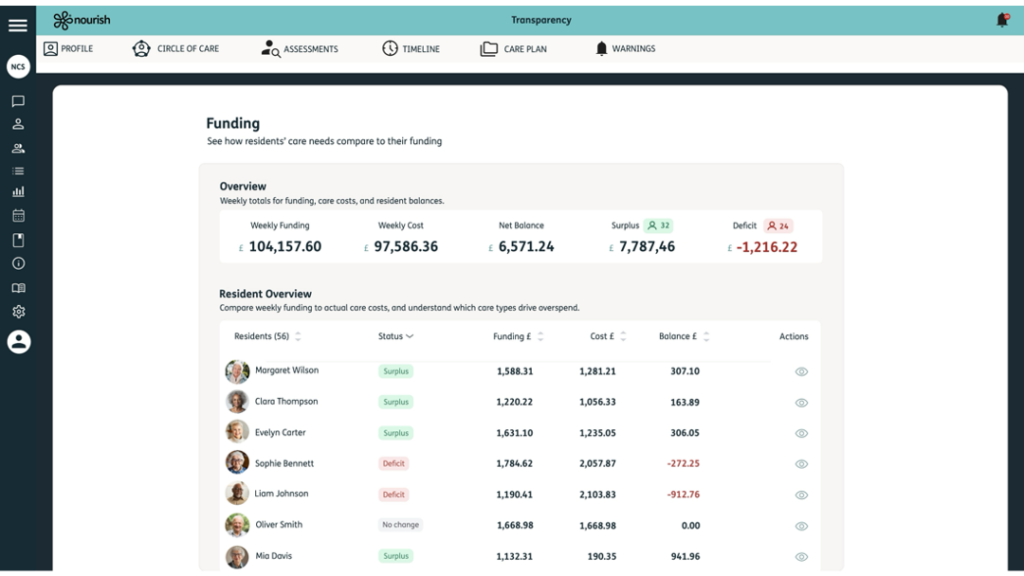
In our Nourish Transparency case study video they detail how the solution helps them to demonstrate a clear picture of the level of care the people they support need, and the true cost of their care.
With reports and dynamic sampling functionality Nourish Transparency enables them to specifically and accurately evidence the level of funding required to deliver quality care in their community.
The Nourish Partnership Conference 2026 was held on September 8th, at the Waldorf Astoria in London.
The event highlighted and celebrated how connected digital ecosystems work best when the people behind them work together.
A day to remember
Throughout the day our partner expo gave providers the opportunity to meet the people behind the technology, discover new solutions and discuss how different systems can work together around their unique needs.
While in person and on stage our partners, guests and fine selves will address some of the biggest questions shaping care technology from workforce and privacy to AI and data. All underpinned by a commitment to digital connections and, crucially, human ones.
Digital Excellence in Care
We also celebrated the inaugural DEC awards, Born from the co-produced Digital Excellence in Care Framework, the awards celebrate organisations leading the way in digital care and support. The awards recognise care providers using technology and data with purpose to improve quality, safety and outcomes.
AI can help care teams work more consistently and spot risk earlier. However, social care is a deeply personal service that is both context-heavy and filled with risk. Which means we need strong governance and clear guardrails for AI. The English social care regulator, the Care Quality Commission, recently released their guideline for the safe and effective application of AI in care settings. In this blog we explore how to design AI for social care that exemplifies these standards so it can best elevate the quality of care and support available.
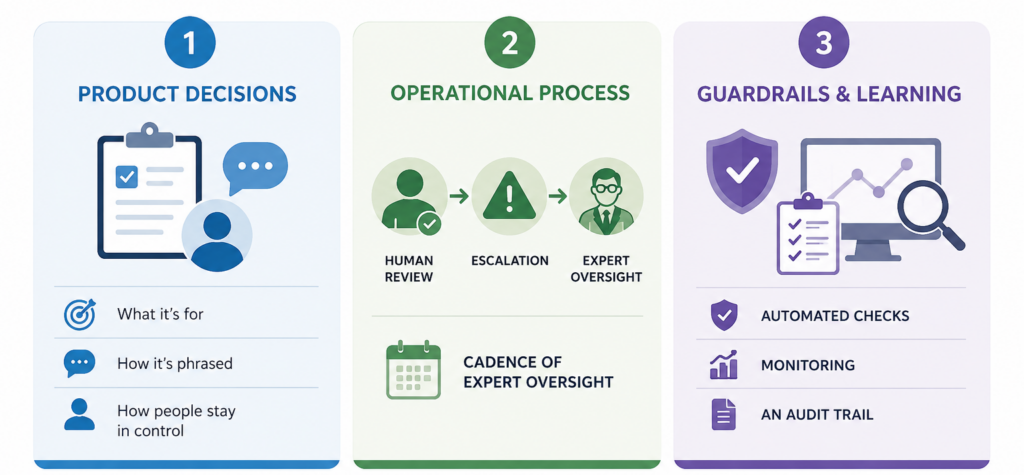
In practice, safe AI is more than just a ‘model’, it’s a product. When we view it as a product, it is easier to make deliberate product decisions for the application of the model. Decisions like, what the AI is for, how it’s presented, and where humans need to stay in control on the output. We must put sensible processes around our reviews. As well as adding automated checks and record‑keeping so we can learn and improve over time.
Inputs > AI suggestion > safety checks > human review > learning loop
The details vary by product, but the principles don’t.
Data input: Define boundaries and responsibilities
Start by being clear about boundaries. What information the AI can use, what it must ignore, how up-to-date the inputs are, and who owns data quality. This prevents false confidence and makes issues easier to investigate.
Expert context: Encode clinical intent before inference
Care quality depends on domain knowledge. You should build and maintain clear guidance on ‘what good looks like. This is in terms of terminology, standards and policies. Crucially, with named owners and a review cadence. So the AI stays aligned with your service as practice and policy evolve.
AI analysis: Require evidence, not opinions
Whatever the AI outputs, it should be available to review. Which means showing the relevant source text and including a brief explanation. You want to avoid the logic of ‘because the model says so’. It is vital that the evidence the model utilises is identifiable and interrogatable.
Automated guardrails for AI: Validate before humans see it
AI can be trained to add lightweight automated checks. These are useful for catching the obvious problems before a human sees them. For example, unsupported claims, inconsistencies or repeated items. These checks don’t need to be fancy or overly detailed, however, they do need to be reliable.
Support check: Is the suggestion grounded in the record?
Consistency check: Does anything contradict other outputs?
Noise control: Remove duplicates and low-confidence clutter.
Policy checks: Enforce a few non-negotiables your organisation cares about, including known issues for AI models like bias, fairness and hallucinations.
Human-in-the-loop: Keep clinical judgement in the driver’s seat
We must keep humans in control. You should design the experience so reviewers can quickly understand the suggestion, accept or reject it, and escalate edge cases. Then use real-world feedback to improve the system on a regular cadence.
The goal is simple, make it easy to do the right thing, and hard to do the wrong thing. The reality is simpler than you’d suspect to achieve.
Responsible AI is also a product problem
There are a number of risks in AI that are well documented. It is important to note some of the AI risks in social care don’t come from ‘the model’ alone. They come from product decisions like wording, defaults, missing context, and unclear accountability.
It is important that you address these issues with your product teams. Once these basics are set, governance becomes repeatable.
Be clear about the role of AI The model suggests, humans decide.
Design for review Make sure to show context and make disagreement easy.
Make uncertainty safe Include clear escalation paths for high-risk or unclear cases.
Be transparent Understand what the model looked at, and what it can’t do.
Governance processes you need and how to operationalise them
Governance is how you earn trust over time, and sets the standard for your guardrails for AI. It is vital to test, monitor, update safely, and keep an audit trail of your actions.
Evaluation: Agree what “good” looks like, then keep testing it!
Before you ship any new features it is crucial you test against a reference set of real cases reviewed by experts. After you ship, keep sampling and checking performance so any drift that occurs doesn’t surprise you. A good way to do this is to define a small set of ‘go/no‑go’ checks for your releases. Be explicit about data handling and access. If you can’t explain those basics, you can’t govern the system.
Change control: Make updates safe (and easy to roll back)
Treat updates like a high-stakes product release. Ensure you are doing everything thoroughly, document changes, getting the right sign-off, and make rollback a straightforward process.
Metadata and auditability: Make every finding explainable
Audit trails are essential aspects of guardrails for AI. You need to keep an audit trail so you can answer important questions and evidence your working. Questions like, ‘What did the AI see?’ ‘What did it suggest?’ and ‘What did the human decide?’.
Inputs: What record and when?
Outputs: What was suggested and why? (with supporting context!)
Decision: What the reviewer did? (and any escalation)
The roles behind responsible AI in care
Data and data security
The effectiveness of any AI system depends on the quality, relevance, and governance of the data it uses. Organisations should be able to clearly explain what data is being used, where it comes from, and how it is curated to ensure it remains accurate, current, and appropriate for the task at hand. This curation process is critical, as it provides the AI with the right context, rules, and safeguards to support decision-making in complex care environments. Rather than relying on vast amounts of unstructured information, responsible AI carefully selects data sources that reflect best practice, regulatory requirements, and the realities of delivering care.
Equally important is the security of that data. Care providers, practitioners, and the people they support place significant trust in the organisations that handle their information. AI vendors should be transparent about where their products are developed and hosted, how data is stored and processed, and the measures in place to prevent unauthorised access, misuse, or data leakage. This includes robust technical safeguards, strong governance frameworks, and ongoing monitoring to ensure sensitive information remains protected at every stage.
A basic checklist before you ship
Safe AI in social care comes from disciplined choices. Teams that design for review, keep humans in control, add sensible checks, and maintain an audit trail. With these guardrails for AI it can quickly become a practical support for care teams. One that they can trust because they can understand it without asking them to accept the findings of a ‘black box’ at face value. Below is a basic checklist for your team to utilise. This is designed as a starting point for your team and is not definitive. After all, AI models, like care communities, are at their best when they champion their unique perspectives!
Humans stay responsible: Clear review and escalation workflows
Test before release: Utilising real, expert-reviewed cases as your benchmarks
Release safely: Include simple go/no-go checks and rollback functionality
Log decisions: Record all of your inputs, outputs, and reviewer outcome
Structured process for review: Plan for ongoing testing and evalution
Keep improving: Conduct regular expert oversight and monitoring
Mardale Group’s care ethos is rooted in three C’s, competence, choice and compassion. Or, as Ollie Smith, Mardale’s Head of IT, put it. “We work in our residents’ home. They don’t live in our work environment.”
It is no mean feat to meet the personal and varying needs of the people they support, let alone support their ambitions for tomorrow! The teams at Mardale are committed, experienced and engaged with their guiding values of competence, choice and compassion. They are also skilled at using technology to support their community. With a decade of digital experience under their belts, Mardale are adept at harnessing technology to achieve human goals. They have used Nourish Better Care to support their services for over 3 years.
Never one to rest on their laurels, Mardale sought to improve the quality of their service, by improving the oversight of and insights into their services with technology. This led them to implementing Nourish Confidence. Our new functionality that brings audits, actions, and AI powered care plan improvement opportunities together and smoothly integrates them into care workflows on our Better Care platform.
We sat down with Mardale’s Head of IT Ollie Smith to discuss how Nourish Confidence supports their care values, improves their approach to audits and helps them utilise AI in a responsible, impactful way for their community.
“I’m 100% confident in the AI Care Plan Audit.”
Ollie Smith
Head of IT
Section links
Why Confidence Using technology to build understanding and champion lived experience
Beyond Dip Testing How Nourish Confidence moved their monthly care plan audits from a fifth of their service to the full residence
Key Categories The way Mardale focused findings from Confidence to their unique needs
Risk Reduction Confidence’s significant impact on risk management at Mardale
Richer Care Plans Improving personalisation and detail in care plans with Confidence
Flipping the Script How Mardale utilised Confidence to change their focus from what peope can’t do, to what they can!
On the Ground We discuss Mardale’s teams experience with Confidence
Why did you choose to implement Nourish Confidence?
“One of the main motivations for our adoption of digital tools is to give our care teams the tools to be able to support our residents. Especially when it comes to oversight. We want our teams to be able to identify any changes in the people we support. Whether they may not be their normal selves or how they are on a regular basis. Digital tools help us factor in everyone’s history so we can better understand their present.
“A lot of people can remember a time when it was on paper and you just wouldn’t have that oversight. You’re never going to be able to summarise a decade of paper records like that. Whereas now with electronic systems, it’s bringing all that data together and giving a true representation of how someone lives their life and how they want to live their life. In a way that is much more accessible and implementable.
“Nourish Confidence is the next step in us championing competence, choice and compassion for the people utilising our services.”
How have you found using Nourish Confidence?
“We’re really happy with Nourish Confidence. The main tool in Confidence that caught our eye was the AI care plan audit. The reason being, a care plan is a key piece of information for how our support team can support the resident and enable them to live the way they want to live.
“We’re able to audit every care plan in the same amount of time we would have spent dip testing care plans previously.”
Ollie Smith
Head of IT
“Now, let’s say you have 300 residents and you have 20 care plan categories per each resident. That’s quite a lot, and quite standard. We would love to check them every day or even every week. But in reality, that doesn’t happen and it can’t happen. With manual care plan audits we would select a handful of residents a month and we would audit those residents and those care plans. But that still leaves, in and around, 250 other residents that potentially aren’t being checked every month. Which means they’ll fall into the next month. Over time this caused gaps to appear. You can see how this is not conducive to quality care and support.
“Nourish Confidence has just been so powerful for our audits. The insights that we’ve been able to see, purely by the monthly run, have been game changing. What’s even better is it will scan everything all at once so you can see an overview of all residents monthly.”
How has this process impacted your oversight of your services at Mardale Group?
“We’re able to audit every care plan in the same amount of time we would have spent dip testing care plans previously.
“When we were dip testing we’d be able to review about 20% of the people in a service a month. Care plans are incredibly detailed, and they take time to review and audit properly. For example, say one of our buildings is 82 resident capacity. We would be looking at roughly 15 residents or 20 residents a month. Which means there are 60 residents that aren’t being audited that month for their care plans. Now, thanks to Nourish Confidence, we can review them all with the level of depth and insight that they need.
“We’ve been testing Confidence for this exact purpose since we first implemented it and I’m 100% confident in the AI Care Plan Audit.”
“Confidence has had a massive impact on risk reduction for us at Mardale Group. It ensures we have uniform information across the system for each resident. Honestly, we didn’t really know the extent of the issue for us before Confidence highlighted it!”
Ollie Smith
Head of IT
How do you specify Nourish Confidence to your services’ needs?
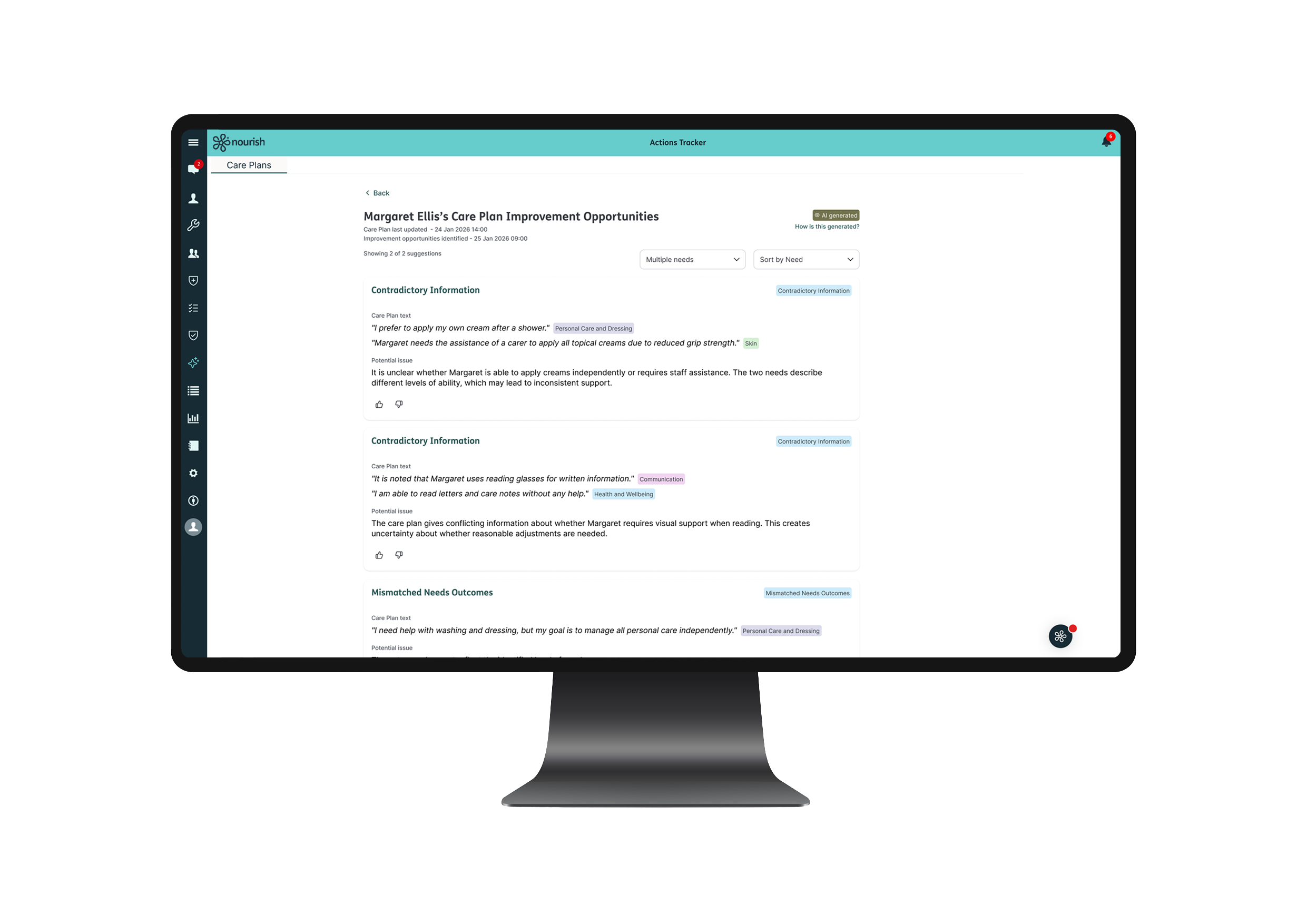
“We’ve selected some key categories that we want to focus on ourselves in the Confidence reports. We started with contradictory information. That’s the first thing that we go for.
“Because at a glance, something in the care plan has been changed and updated, which is great because it needed to. The person’s care need had changed, that happens a lot. But, outside of the care plan section, there’s critical information which hasn’t changed. So, someone may have updated the care plan but not updated the critical information. Confidence’s automatic audit tells us straight away that there’s something conflicting here. That’s such a powerful piece of information for us to easily and routinely see, it can be genuinely life changing!
“Let’s say someone’s continence needs have changed. But something in the critical information which sits outside of the care plan section hasn’t been updated to reflect the care plan change. That’s really important for us to notice and address. The continence care plan has changed, but then actually their nutrition and fluid intake care plan hasn’t been changed.
“Confidence enables us to prioritise the improvement opportunities it highlights to us. Which ensures we are locked in on the right areas of focus for the people we support.”
Do these insights help you manage risk in your service?
“Confidence has had a massive impact on risk reduction for us at Mardale Group.
“Summarised, a lot of the insights come back to risk, especially with contradictory information. If someone is an agency member of staff or not, it depends on where they are going to look for information. If they could look at our system and get contradicting information, it’s dangerous.
“Our application of Nourish Confidence ensures we have uniform information across the system for each resident. Honestly, we didn’t really know the extent of the issue for us before Confidence highlighted it!”
What other information points does Confidence help you address?
“Confidence has a lot of different useful categories which we review. Another one we use is ‘Insufficient Care Guidance’. It’s a great indicator of opportunities to improve personalisation and depth of information.
“It highlights that we explain someone’s situation but potentially doesn’t specifically say how to care for that person. How to help that person and how to support them to be able to be independent. Whatever their goals may be, how we can help them achieve them.
“Confidence highlighted something else where we can be a little bit more specific. An opportunity to get the best outcome effectively by picking up on common times or the best methods to do it. That’s what we want technology to do for our service. Inform decision making and empower our teams to deliver outstanding care.”
Ollie Smith
Head of IT
“For example, say in the care plan text we have eating and drinking. The person has a history of poor appetite and reluctance to eat. The plan explains that this person has a long history of poor appetite, low BMI, and relies on fortisips.
“Staff are told to encourage support of oral and fluid intake and to offer food. But it doesn’t necessarily say how often to or how the person would like to be offered the food. Or what worked previously to help this person get the fluid and food that they need.
“What makes Confidence so impactful, is that if we were doing our manual audit, we probably wouldn’t have thought anything wrong about that example. We’ve specified the current situation, we’ve specified the expected outcome, and we have specified to offer a prompt for the intake. It’s not a bad care plan.
“But Confidence highlighted something else where we can be a little bit more specific. An opportunity to get the best outcome effectively by picking up on common times or the best methods to do it. That’s what we want technology to do for our service. Inform decision making and empower our teams to deliver outstanding care.”
What is another key category you’ve used Confidence to review at Mardale Group?
“Another key one we focus on is negative language. We go and have a look at that quite a lot. By negative language I mean our care plans sometimes were not focusing on what a resident can do. It was more focusing on what they can’t do.
“Here’s an example. In one of our care plans, which is mental capacity assessment for decision making, we have mentioned the use of no capacity. Which is saying that the person is incapable of making a decision effectively. That’s focusing on what they can’t do. They can’t make decisions. It’s not focusing on what they can do and who can help them with it.
“We find this negativity ripples out across their lived experience. It just makes people feel bad about themselves. It’s not personal, it’s not person-centered either. In the sense that, yes, this person is living with a condition. But they’re living with dementia, they don’t suffer from dementia. That’s an important distinction at Mardale Group, it comes back to our values, and Nourish Confidence is helping us bring our values to bear across our service.
“Nourish Confidence is helping us bring our values to bear across our service.”
Ollie Smith
Head of IT
“The AI is fantastic, can’t fault it. It’s down to how you use it. For us, focusing on a step by step approach of looking at the categories has been really effective. Starting with Contradictory Information, Insignificant Care Guidance, then Negative Language and so on works really well for us.”
How are your teams finding using Nourish?
“We do really love Nourish Confidence. We all consider it a massive support. It highlights how something could be changed. If there’s an area missing or how it could be improved, it doesn’t explicitly tell you how to improve it. That’s not what it’s for, and I think that it’s the right approach.
“We’re professionals, we’re the people who have been trained to be in the role that we’re in. Whether it’s a nurse or creating a support plan. Confidence is the tool to highlight the information that potentially could have been missed. Our teams then address those opportunities through their experience, expertise and personal connections.”
What is it like using an AI that is explicitly insulated within that system and for social care usage?
“Great, we needed it for a long time. I think it’s amazing and powerful and it can only get better. We’re really excited to see where it can go.”
How do you find working with Nourish as a digital partner?
“I can’t sing your praises high enough. We absolutely love working with Nourish. We’ve worked with a number of different care systems before and there’s no comparison. The thing that I love the most about Nourish is you only partner with the best in the space.
“You don’t try and partner with anyone that offers something to do with social care. I use the Nourish partners section if I’m looking for any other solution out there. I know that you guys have vetted them and checked them out.
“As our Head of IT, I have regular account catch ups with your team. They’re always on hand to answer any questions, take feedback and support us. You are a genuinely forward thinking company.”
Joy2Care is a family-run home care provider built on a simple but powerful philosophy, clients become extended members of the family. At Joy2Care, relationship-centred care means treating every person with the same warmth, respect and attention they would expect for their own grandparents. That family value extends across the whole service, through every carer and into people’s homes.
Joy2Care’s journey with Nourish began over 10 years ago, when rotas were still written on paper in the back garden of the founder’s home. Notably separate from the people they cared for. Since then, Nourish has become central to how they deliver person-centred care, improve their operations and keep connected with clients, care teams and families. Bringing together familial commitment and commercial acumen to deliver quality, sustainable, care for their community.
Joy2Care have wrapped Nourish around their service. Nourish Better Care at Home supports first-person care planning, gives families greater visibility through the app, and helps their team communicate clearly and precisely. It has also transformed their financial management, reducing a manual invoicing process that once took weeks down to days, with estimated savings of around £18,000 a year.
We spoke with their Director of Operations, Josh Farrell, to learn more about how Joy2Care utilise Nourish Better Care at Home to improve oversight, reinforce connections, and build for the future.
Centralisation The oversight and key perspectives that support quality care
Communication How Better Care at Home connects their teams, clients and community and supports their operational sustainability
Finance The digital switch that saved Joy2Care around £18,000 annually
Operational Sustainability Utilising Better Care at Home to best understand the demands of their community and supporting them effectively with their teams
“I know what I’m getting with Nourish, a genuine partnership”
Josh Farrell
Director of Operations
How do you approach home care at Joy2Care?
“Well, without sounding really cringy, we’re a family business. So, everyone we work with, all our clients become extended members of the Farrell family. That is how it is.
“I’ve always felt when it comes to supporting people, it’s how you expect your grandparents to be treated. Now, admittedly I’m a bit of a cheeky chap, so I love to have a laugh and joke with them all. That’s because, at the end of the day, they do become like our family members.
“The family values extend to our care staff as well. We only hire people who match our values. I would rather do all the work myself if it means getting the right carers in with the right beliefs. We’re going to look after vulnerable clients in their own homes, you must be the right type of person to be able to do that the right way.”
Why did you choose to join Nourish?
“That was a decision I made about 10 years ago. We used to do rotas on pieces of paper in the back garden of my mum and dad’s house! That’s back when the business was not that old. I wanted us to improve our approach.
“I looked around at our options for a digital partner. Talking with Nourish, and seeing what your system could do, made it an easy choice. We did check out the competition at times, but we always come back to Nourish. We love building with Nourish over the years, tailoring the system to our unique needs.
“These days I don’t need to talk to anyone else because I know what I’m getting with Nourish, a genuine partnership, that’s what I like.”
How does Better Care at Home support your approach to care?
“It just increases the person-centred care side of things through everything. That’s what we’re really big on. We write everything in first person. It’s not ‘Josh is doing this’, it’s ‘I like to’ and ‘I decided to’. Better Care at Home helps us to deliver that even more and become more efficient with everything we’re doing along the line.
“Working with Nourish always feels person centred too. It’s not a one size fits all approach, or at least it doesn’t feel that way. It genuinely does feel like someone’s built a bespoke system for my business. Which I suppose we have done together, over the years, as part of working in partnership with Nourish. I’m certainly a big, big advocate.”
“On Better Care at Home everything we need to know to support our clients is in one place.”
Josh Farrell
Director of Operations
How does Better Care at Home help you review information?
“Better Care at Home is fantastic for centralising all our information. I can come into the office on a Monday and I can check through everything I need then and there. I used to have to drive around and pick up files and client’s notes back in the day!
“On Better Care at Home everything we need to know to support our clients is in one place. That centralisation of information makes a huge difference to the quality of care we can provide, in a way that supports the personal, familial connections that define our approach to care.
“Which makes life so much easier. We’re not clicking through everything and then forgetting what you clicked on and having to backtrack through different systems. I can just go where I want straight away, and I can review what I need straight away.
“I don’t need to be in the office either, which is so important with home care. I’ve done it on my laptop and on the phone when I’m out and about. I can just log on and see everything. Rather than relying on phone calls and WhatsApp messages I can see firsthand that everything is running smoothly.
“It’s the same with my own holidays. I know you’re supposed to unwind, but we’re a family business, you do check everything. With Better Care at Home you can do that straight away. That level of oversight speeds up our whole business, as it simplifies my communication with our managers.
“It’s really good to see it from our side of view, but also from the client side of view as well.”
“It’s brilliant, it makes it so much smoother for keeping people connected and informed.”
Josh Farrell
Director of Operations
How does Better Care at Home help you connect your clients with their families?
“It’s brilliant, it makes it so much smoother for keeping people connected and informed.
“I’ve had some really good feedback from family members of people utilising Joy2Care. The daughter of one of our clients went on holiday recently with her friends. While she’s on holiday she logs into the app to check in on everything. Her mate is blown away, asking her ‘Wow, what’s this?’ So she takes her through it. Two weeks later, her mate is calling us, asking us to assess her mum based on what she saw on holiday!
“So that’s helping us both improve connections through our service and expand our business!”
How important is communication to your care quality?
“Communication is crucial for quality, and the communication in Better Care at Home is great. It’s a big focus for us. It’s key to any business being successful.
“Communication is crucial for quality, and the communication in Better Care at Home is great.”
Josh Farrell
Director of Operations
“It’s about good communication, not just talking for talking sake. The same is true for digital communication. It needs to be clear and precise. That’s what Better Care at Home’s communication features are like. It’s focused on what you want to talk about, and just helps you move on with everything.”
How do your team find using Better Care at Home?
“Our team really like it. We have introduced a lot of the different functions in the system over the past few months. We realised a while back that we weren’t utilising everything we could on the platform.
“Over the past few months, as we’ve gotten more comfortable with the new features, we’ve been utilising a lot more on the system. We’re just getting more and more used to it, and everyone seems to really like it.”
How does Better Care at Home help you manage the financial side of your home care service?
“The invoicing is fantastic! The finance functionality in general. Especially from my perspective as that’s my side of the business. At Joy2Care we used to do invoicing manually, in quite a convoluted way. We’d count it all up, put it onto a Word document and so on. That used to probably take about two-three weeks, solid time, to get all invoices sent out.
“Since I moved that process over to Nourish it takes two days. The total savings for us are about £18,000 a year by just moving over the invoicing. It makes the whole process so much smoother, and transparent.
“It’s particularly useful for client feedback as well. It’s so good because you get the breakdown of all the things. And what I like as well is what we used to have as a problem. People would call in to make a payment and it would all be on a spreadsheet. If a senior manager wasn’t immediately available manager wasn’t immediately available.
“Now, because it’s on the system, they can explain it directly. Nourish shows your invoice is £2,500, here’s why. It’s great to have that resource and tick everything off easily.
“The reporting side of things is also great. It simplifies my life by making it easy to see how much money is outstanding. I can check what’s owed and who’s owed it, resend out the invoices where necessary. We can even track our emails. So, when people go, ‘I’ve not received the invoice’ I can load up Nourish and review the email, where it was sent and if it was opened. This helps us keep our communication effective and transparent.
“The level of financial savings, control and insight Better Care at Home brings to our service helps us prepare and build for our future sustainably.”
Operational sustainability is crucial in home care, how does Better Care at Home help you manage your teams and ensure they are set up for success?
“We also use the system to review how many care calls, care workers and so on when planning rotas.
“There’s so much useful information captured by Better Care at Home that we can take into account. Things like the functions where you can look about how many late appointments we’ve been to. I always have a look at that and then talk to my team about rostering. ‘I can see we’ve had this many late appointments, what’s the reason?’ ‘How can we solve this issue?’ It’s always good now.
“It’s helped me learn about how many carers workers I need, and when I need them. I can see our low demands times, and I can plan more effectively for late shifts. Each day I know how many carers I need. I know whether they are walkers or drivers, I know everything and that’s helped me so much with our operational planning. I used to spend hours building those kinds of reports on our back end. Better Care at Home makes it all so much easier to understand.”
How do you feel about Joy2Care working with Nourish and the future of our digital partnership?
“I love working with Nourish. Every time I’ve needed support, or guidance you’ve been there.
“For example, a big part of us saving so much money with invoicing came from the support and guidance of your team.
“That’s why I won’t leave. You’ve been so good with us, like a member of our extended family.”
In 2017, the Public Health Outcomes Framework reported that 220,160 emergency hospital admissions were related to falls in the over 65 age group. A fall can have enormous repercussions to someone’s life, affecting their mobility, independence and health. Utilising Nourish and making some key changes can minimise the risk of a fall within your care service.
Nourish Insights Dashboard
Oversight is essential for quality care, whether you’re in a family run business or a franchise. Our Insights Dashboards are built to highlight the most relevant information on your Nourish platform, in the most accessible, and actionable way for your team. Creating a clear workflow from point of data recording, through review, decision making and back to positive impact for the people you support.
Nutrition & hydration
Staying hydrated and drinking enough fluid is important. Drinking consistently throughout the day, rather than attempting to hit the desired fluid intake in the latter half of the day, will decrease the risk of other health complications. This can include urine infections which can cause delirium and increased confusion, increasing the likelihood of a fall. Desired fluid intake and MUST scores are incorporated in Nourish, allowing you to keep an eye on the hydration and nutrition of the people you support.
Encouraging more activity in falls prevention
According to the NHS, exercise can decrease the risk of a fall, particularly strength and balance training. Strength and balance training can involve activities as simple as walking or dancing. Tai Chi is another exercise that can prevent falls as it emphasises on movement, balance and coordination. Activities can be logged in the Nourish app as can the level of participation and enjoyment. This will allow you to see how and if exercise has made any improvements to a person’s mobility.
Appointments
Appointments can be logged on the Nourish app and can be viewed as part of the daily care plan of the people you support,giving greater visibility for your care team. Seeing the podiatrist to check that nails are not overgrown or suffering any ailment that may make walking difficult. Also on footwear, you can add into the daily care plan a requirement that checks the people you support are wearing suitable and well-fitting footwear. Regular check-ups with the opticians will checkthe people you support are wearing the appropriate eyewearfor their needs. You can also add a note into the care plan. This givesyour care team the ability toeasily view who wears glasses.
Falls Champions
It may be useful to identify a Falls Champion for your service. Some local NHS trusts and councils hold training for Falls Champions. Champions are advocates for prevention and management of falls. They can ensure that staff are following fall management protocols. Champions can analyse data to see how and why falls are happening and implement measures to prevent this. Champions additionally ensure risk assessments are being followed for those at greater risk of a fall e.g.the use of sensor mats or alarm pendants.
Medication management
Some types of medication and combination of medications can increase the risk of falls. Having the oversight via an eMAR solution alongside other care records and information gives the ability to monitor, manage and evaluate a person’s medications. With a view to reducing falls risks and associated complications.Being able to monitor this medication and provide visibility of symptoms among your team can increase awareness and reduce the risk of falls. As well asregular medication reviews to assist in ensuring side effects and symptoms are monitored. Nourish integrates with various eMARs, allowing you and your team to see what medication the people you support use.
Integrations
We designed Nourish to be the base for your digital ecosystem. We integrate with variouseMAR solutions, pain management apps, eRedBag and GP Connect, encouraging interoperability in health, care and support. Additionally, we are always looking to integrate with technology supplier who can improve the lives of the people we support.
Iden Manor is a unique care home, where the purpose of history and the potential of tomorrow walk hand in hand. They pride themselves on providing an inviting space, where the character of both their long-standing Victorian manor house and their compassionate teams, combine to offer a service unlike any other.
However, for all the little details that make them unique, they faced a challenge familiar across the sector, funding. More specifically, how to clearly evidence and justify the true cost of delivering high-quality care.
Fortunately, they were well equipped to answer this question thanks to their innovative new solution, Nourish Transparency.
Nourish Transparency Case Study Sections
The challenge: Justify care costs to local councils to secure appropriate funding for care. The approach: Use Nourish Transparency to clearly articulate, through an evidence based model, the true cost of care. The outcome: A well evidenced case justifying their price and securing their service. The impact: A more balanced, informed dialogue with commissioners
The challenge: Evidencing the true cost of care to councils
“We noticed a shift away from us being a first-choice placement, with a stronger focus on lower-cost options.”
Jean Reeves-Yates
Home Manager
Cost is at the forefront of decision making for local authorities in England. An understandable position given they are spending, on average, three quarters of their budgets on social care. In such environments the push to reduce cost can quickly outweigh the reality of care provision.
“Following recent changes within our local council, funding has become more complex and challenging for us,” explained Jean Reeves-Yates, Home Manager for Iden Manor. “We noticed a shift away from us being a first-choice placement, with a stronger focus on lower-cost options”
“They referred a person who was in a residential dementia setting to us. We followed our normal procedure, assessed them, costed their care and presented it to the council. They declined.”
The challenge for Iden Manor was clear. They needed a way to demonstrate, in a structured and credible format, why their cost of care reflected the level of need, quality of provision and value to commissioners. As something more than a price point, as a transparent reflection of what safe, effective care actually requires.
The approach: Transparency in costing brings clarity to care needs
Iden Manor used Nourish Transparency to rebuild their costing with a detailed, evidence-based breakdown.
“There was quite a bit of tussle back and forth with the council,” said Jean. “I do believe that they went to another home to assess the person being supported as well.”
“I sent this costing across to our local council. This time, with clear evidence backing up our cost breakdown.”
Jean Reeves-Yates
Home Manager
By switching to Nourish Transparency to help them make their case, Iden Manor were able to clearly articulate a new level of detail when presenting to their council.
Including:
The specific care needs of the person supported
The staffing levels and skills mix required
The true cost of delivering safe, high-quality care
“I then costed it using Nourish Transparency,” Jean continued. “I sent this costing across to our local council. This time, with clear evidence backing up our cost breakdown.”
The outcome: The best case for the best care
“They accepted the updated offer we provided!” said Jean.
“Of course, I don’t know what other providers had costed, or what the council were paying previously. But I do know that the level of care required meant we needed to charge at our higher rates.”
Iden Manor used Nourish Transparency to provide the required evidence and cost analysis to secure funding. While final placement decisions always depend on multiple factors, Transparency specifically enabled Iden Manor to:
Confidently justify higher weekly rates (approximately 71% above typical local authority expectations), reflecting the high complexity of need and the staffing levels required to deliver safe, high-quality care
Move from subjective pricing discussions to objective, evidence-backed conversations
Strengthen their position in negotiations with commissioners
Clearly differentiate their offering based on quality, outcomes and care needs, not cost alone
The impact: Changing the cost of care conversation
“It’s already proving far more beneficial than I originally thought it would.”
Jean Reeves-Yates
Home Manager
Iden Manor used Nourish Transparency to change the conversation they were having with their commissioner. They moved the discussion from
Can this be delivered at a lower cost?’
To something more meaningful:
‘What is genuinely required to meet this person’s needs safely and well?’
That shift matters. Because sustainable care cannot be built on a race to the lowest price, it has to be grounded in a clear understanding of need, resource, and quality.
The second conversation is one where Iden Manor have the edge. And when conversations turn back to cost, they have Nourish Transparency.
“It’s already proving far more beneficial than I originally thought it would,” concluded Jean.
In an increasingly competitive and cost-sensitive market, clarity is critical. First of all, so providers can secure placements. But beyond that, for ensuring that care providers are funded well enough to adequately support their communities and sustainably enough to continue to do so into the future.
If you’d like to find out more about how Nourish Transparency can help you secure your future, contact us directly today.
Digital care record systems have gone from a ‘nice to have’ to a ‘need to have’ in social care. Most providers have moved to a digital system or are in the process of implementing one. With widespread digital uptake the question has changed from; ‘are you using a digital system?’ to ‘are you using the right digital system for your service?’
Just under two years ago the government launched its ‘Digitising Social Care’ campaign, delivering the three year £150 million investment for digitally transforming adult social care, as was set out in the 2021 white paper, People at the Heart of Care.
This campaign built on a decade of digitisation in Social Care. Driven in part by the pandemic. That saw care providers take on a variety of different digital systems to help them deliver outstanding care.
The driving force of the ‘Digitising Social Care’ campaign has focussed on ensuring 80% of providers, and at least 80% of people in receipt of care, have a Digital Social Care Record (DSCR) that is compliant with their standards in place by March 2024. While it fell slightly shy of this target. There has still been a significant uptake in digital social care records. From the 40% of providers using them at the start of the campaign. The uptake reflects the benefits of digital systems in care, and the necessity of compliance with the established DSCR standards. These positive results have led to the government extending funding for the campaign until March 2026.
Evaluating your system
Nourish Care was the first system to join the NHS England Assured Solutions List back in 2021. Since then, the list has grown significantly, so how do you choose the right one?
Incompatibility between systems and services is a rising source of operational frustration for providers. ‘All-in-one’ systems can be limited by the applicability and lack the resources to support more complex or person-centred care, while specialised systems can be disconnected, leaving your team to fill in the gaps between them manually.
Routine system evaluations are a great way to uncover and address these frustrations. This process involves identifying the issues with the platform you are using and evaluating the impact of this issue on your organisation. It takes time and effort to establish the best criteria sets for your service. We have included a guide which you can use to help you get started.
It takes a village
Digitisation has impacted everyone involved in care, so it is best practice to include your entire organisation in the evaluation process. Any frustrations caused by your digital system will be felt by carers and coordinators alike.
Your organisation has multiple roles and responsibilities, and it is important to involve them in your evaluation process through interviews and surveys. An example of some common roles are:
Frontline workers who provide care and support
Service managers who are responsible for individual services
Area managers who are responsible for specific regions and/or care types
Central leadership who are responsible for strategy, policy and compliance
If possible, you should also involve the people who utilise your service in this process, such as when evaluating the effectiveness of integrations with other systems like PainChek or GP Connect as well as circle of care functionality like a family portal.
The more experiences you can account for when evaluating your system, the more complete your picture of its impact will be.
Considering your people
Digitisation in Social Care happened at such a rapid pace since COVID that, understandably, some people have been left behind. When evaluating the impact of your system it is important to consider not just the functionality, but also the user experience.
Do your team feel confident not only with the system, but with the support they have around it? Are there resources and training available to help your team improve their understanding of the system? Is there a customer support team they can reach out to for guidance and support?
Many issues with digital systems come from their misapplication. When evaluating your current digital platform, it is vital to consider your team’s comfort with the system. It might be a matter of reviewing and reworking the way you are implementing the system, as opposed to changing your system all together.
The right roadmap
To provide outstanding care, you must constantly be reviewing and improving upon your processes in a responsive and caring way. It is natural to expect the same of your system, as you both adapt to the always evolving reality of care provision.
Digital skills develop over time. With that time it is common to look for more ways to apply your skills to support your care. Such as through data reporting and analysis. By routinely reviewing the capabilities of yourself and your system. You can make sure you are maximising the benefits of your digitisation journey.
Evolving standards for digital care record systems
The new DSCR standards must be fully met by everybody on the ASL. They represent the next step of Social Care’s digitisation journey. An evolving emphasis on data, security and interoperability that reflects the success and potential of digital software in care.
The new compliance regulations were announced last year and Nourish has been busy ensuring that it meets each of the 14 standards. This level of screening will mean that only software suppliers who meet stringent standards will be able to remain on the NHS Assured Solutions List.
The power of knowledge
With so many options available to care providers for digital systems, it is the perfect time to review the needs of your service and community. There is a wealth of suppliers eager to explain their system and its capabilities to you. By knowing what you have and what you want from a digital platform. You will be well-equipped to get what you need.
Designed for Education, Children’s Homes and Complex Needs
Nourish Better Care is a tool that reflects your world, your values, and your young people. We help over 3,850 different services and providers to plan, record and coordinate care and support.
Supporting children and young people requires consistent communication, clear records, and person-centred planning. Nourish Better Care brings these elements together into one secure, easy-to-use system, giving teams access to real-time information, structured records, and practical tools to support day-to-day care.
Aligns with safeguarding and inspection frameworks (e.g. Ofsted, CQC)
Designed for flexibility across children’s homes, SEND schools, and independent services
Reduces admin pressure and helps staff focus on providing high-quality support
Enables collaborative planning and meaningful participation for all
Supports evidencing outcomes, tracking progress and improving consistency
Supporting Every Part of the Journey
My Journey, our new person-centred Goals & Milestones feature, is designed to transform aspirations into visible, meaningful progress. Built for SEND and LD services, it allows every individual’s goals to be co-produced in plain, accessible language and broken into achievable steps that can be tracked in everyday support.
With rich, mobile-friendly progress updates, including reflections, confidence levels, time spent, and photos, My Journey creates a living record of growth that celebrates each person’s achievements while giving teams, families, and commissioners clear evidence of impact.
It brings outcomes to life, empowering organisations to see, share, and champion progress in a way that is truly human.
Supporting features
Critical Information
Quick access to essential information when it matters most. Teams can configure what’s shown first for each child, so legal status, safeguarding needs and key risks are always visible. Clearer insights and faster decisions, especially in high-pressure situations.
Positive Behaviour Support (PBS)
Consistent support starts with better visibility. Record and review behaviour episodes in one place alongside strategies used and outcomes. Identify patterns, improve responses, and evidence what works for each child.
Transition Pathways
Real-time tracking of movements and supervision levels. Staff can clearly see where each child is meant to be, reducing confusion, improving safety and strengthening compliance across settings and shifts.
Voice of the Child
Create space for every child to be heard. Simple, digital tools allow children to share how they feel in their own words or images. Contributions feed directly into records and planning, making participation real and consistent.
Child Calendar
A complete view of each child’s schedule. From school and appointments to contact visits and transitions, everything’s visible in one place. Helps avoid missed commitments and improves coordination across teams.
My Journey
Track what matters and celebrate progress with Goals & Milestones. Set meaningful, personal goals and link them to everyday care. Progress is clearly visible, helping teams adapt support and evidence development over time.
Talk to us today
Find out more
Continuous Improvement
Nourish Confidence
Nourish Confidence brings audits, action plans and AI-assisted care plan reviews into one place, helping care teams identify risks, prioritise improvements and track progress.
When information is spread across different systems important signals can be difficult to spot early.
Care and support plans may be sampled, audits completed in spreadsheets, actions tracked in inboxes, and incidents recorded separately. Dedicated teams provide individualised care every day, yet without an integrated view, understanding the whole picture can be more difficult.
Nourish Confidence changes that. It pulls the right information into one place, enabling teams to gain clearer visibility of emerging themes and a sharper sense of what to prioritise next. Nourish Confidence brings audits, actions, and improvement opportunities into one platform – designed for care workflows – so teams can identify risks early, act quickly, and continuously improve without adding manual burden.
A look at Nourish Confidence
The benefits of Nourish Confidence
Safer, more consistent support
Earlier visibility of themes helps teams adjust practice before issues escalate.
Clearer, more aligned care plans
Teams can ensure care plans are consistent, clear and truly reflective of each person’s individual needs.
Better follow up
Linked information reduces missed steps and supports more reliable post-incident actions.
Visible service improvement
Across the service, people gain a clearer, more aligned understanding of quality and progress across the service.
Where Nourish Confidence fits in your organisation
Confidence works seamlessly with your care workflows, it’s integrated, not added on. You can bring Confidence into your organisation in two ways:
Combined with Nourish Safety incident management for a complete governance and risk solution
Key features
Suite of Audits
Reduce risk and ensure audits are conducted promptly and
consistently with pre-built, adaptable templates with
scheduling and assignment. It also means a continuously
maintained suite of audits managed by our in-house team.
Impact Dashboards
Leadership-ready views connects
actions to outcomes making excellence visible and evidences improvement for
regulators.
Care Plan Improvement Opportunities (AI-supported, human led)
Move from reactive sampling to proactive
assurance with full-population assurance across
clarity, person-focus, and alignment.
Audit Creation
Run all of the audits your organisation runs today through Nourish with the ability to create audits from scratch with the
ability to add yes/no, numeric and
free text answers and to define what
answers should trigger actions.
Audit Oversight
One hub to plan, balance, and track
audits across services. This allows governance to see where audits are happening or not
and also to see which audits are most commonly finding issues.
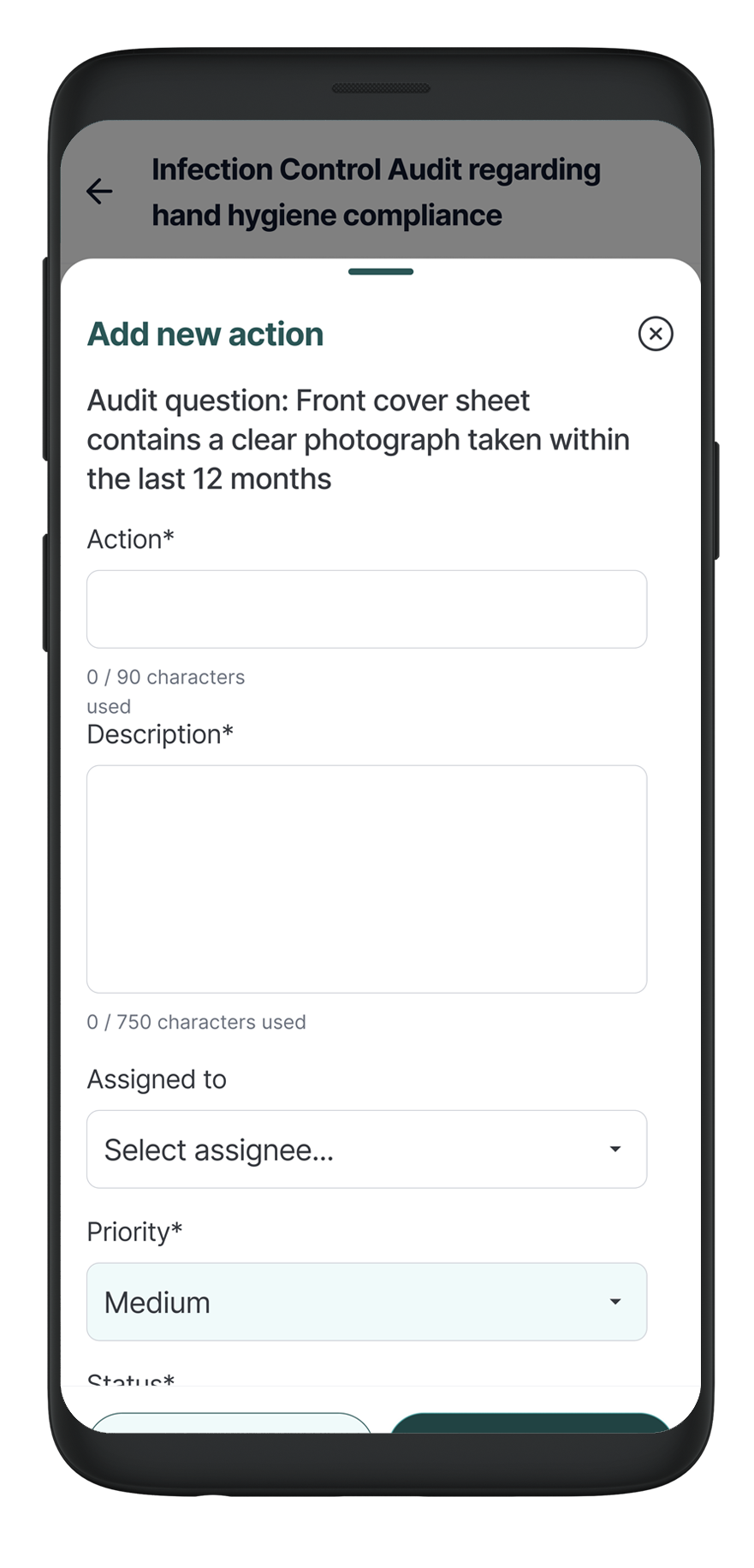
Action Tracker
Close the loop; no lost tasks or duplicated effort with centralised actions from audits,
events, inspections.
Interested in finding out more?
To find out more about how Nourish Confidence can benefit your care service and the people you support, fill in your details to chat to our team.
Learn more about our other products
Nourish offers a wide range of products to help care providers overcome challenges commonly faced in the sector. See what’s right for your service.
Care Delivery
Nourish Better Care
We’ve harnessed the best technology to help you plan, record and co-ordinate care quickly and easily for everyone you support.
Our mobile device management solution enables your team to efficiently record and access information at the point of care, whilst ensuring sensitive data remains secure and protected.
Our mobile device management solution enables your team to efficiently record and access information at the point of care, whilst ensuring sensitive data remains secure and protected.