We spoke to Angie Kemp and Nicola Hughes from Autism Together about the impact Nourish Transparency has had on their service while at the Nourish Partnership Conference.
As early adopters of the platform they have been instrumental in the development and application of Nourish Transparency. Helping to ensure the platform addresses real challenges and offers effective solutions for care providers.
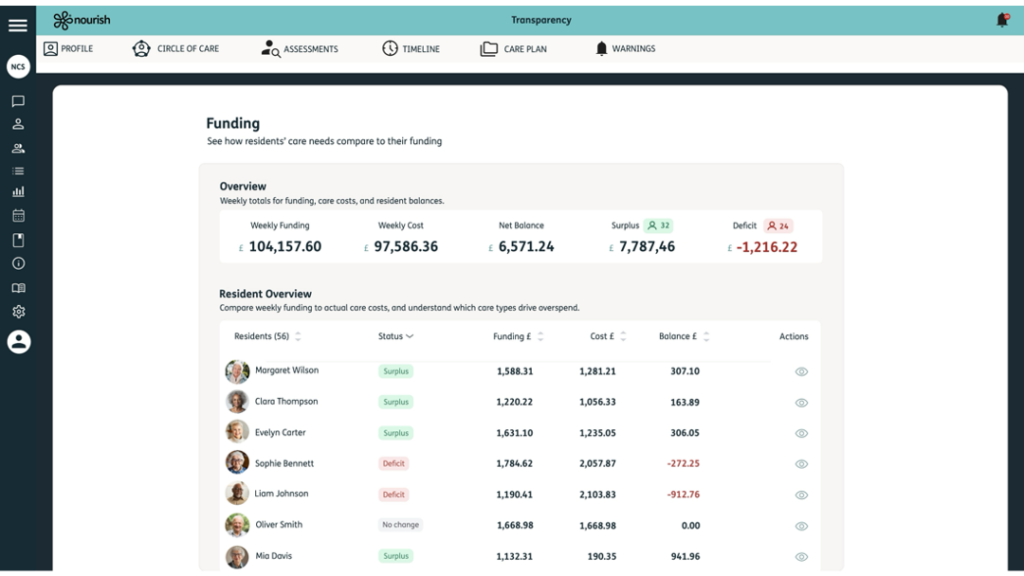
In our Nourish Transparency case study video they detail how the solution helps them to demonstrate a clear picture of the level of care the people they support need, and the true cost of their care.
With reports and dynamic sampling functionality Nourish Transparency enables them to specifically and accurately evidence the level of funding required to deliver quality care in their community.
The Nourish Partnership Conference 2026 was held on September 8th, at the Waldorf Astoria in London.
The event highlighted and celebrated how connected digital ecosystems work best when the people behind them work together.
A day to remember
Throughout the day our partner expo gave providers the opportunity to meet the people behind the technology, discover new solutions and discuss how different systems can work together around their unique needs.
While in person and on stage our partners, guests and fine selves will address some of the biggest questions shaping care technology from workforce and privacy to AI and data. All underpinned by a commitment to digital connections and, crucially, human ones.
Digital Excellence in Care
We also celebrated the inaugural DEC awards, Born from the co-produced Digital Excellence in Care Framework, the awards celebrate organisations leading the way in digital care and support. The awards recognise care providers using technology and data with purpose to improve quality, safety and outcomes.
AI can help care teams work more consistently and spot risk earlier. However, social care is a deeply personal service that is both context-heavy and filled with risk. Which means we need strong governance and clear guardrails for AI. The English social care regulator, the Care Quality Commission, recently released their guideline for the safe and effective application of AI in care settings. In this blog we explore how to design AI for social care that exemplifies these standards so it can best elevate the quality of care and support available.
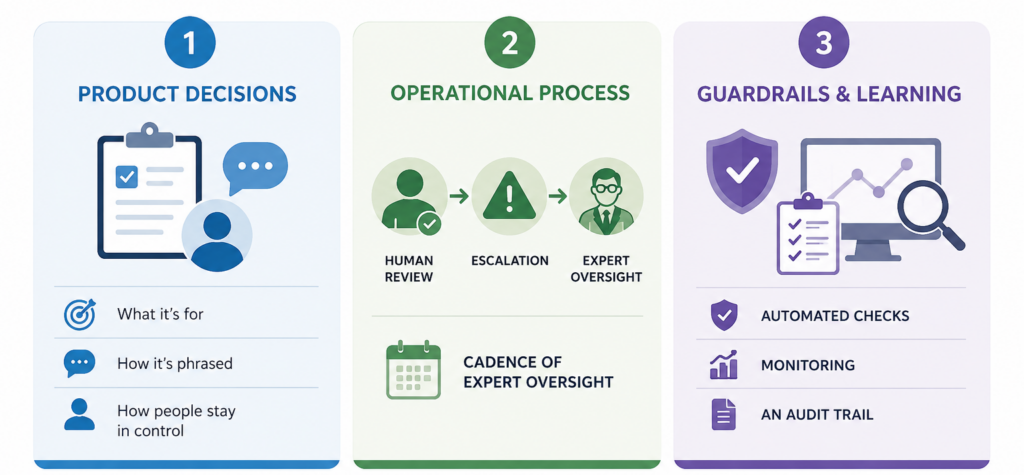
In practice, safe AI is more than just a ‘model’, it’s a product. When we view it as a product, it is easier to make deliberate product decisions for the application of the model. Decisions like, what the AI is for, how it’s presented, and where humans need to stay in control on the output. We must put sensible processes around our reviews. As well as adding automated checks and record‑keeping so we can learn and improve over time.
Inputs > AI suggestion > safety checks > human review > learning loop
The details vary by product, but the principles don’t.
Data input: Define boundaries and responsibilities
Start by being clear about boundaries. What information the AI can use, what it must ignore, how up-to-date the inputs are, and who owns data quality. This prevents false confidence and makes issues easier to investigate.
Expert context: Encode clinical intent before inference
Care quality depends on domain knowledge. You should build and maintain clear guidance on ‘what good looks like. This is in terms of terminology, standards and policies. Crucially, with named owners and a review cadence. So the AI stays aligned with your service as practice and policy evolve.
AI analysis: Require evidence, not opinions
Whatever the AI outputs, it should be available to review. Which means showing the relevant source text and including a brief explanation. You want to avoid the logic of ‘because the model says so’. It is vital that the evidence the model utilises is identifiable and interrogatable.
Automated guardrails for AI: Validate before humans see it
AI can be trained to add lightweight automated checks. These are useful for catching the obvious problems before a human sees them. For example, unsupported claims, inconsistencies or repeated items. These checks don’t need to be fancy or overly detailed, however, they do need to be reliable.
Support check: Is the suggestion grounded in the record?
Consistency check: Does anything contradict other outputs?
Noise control: Remove duplicates and low-confidence clutter.
Policy checks: Enforce a few non-negotiables your organisation cares about, including known issues for AI models like bias, fairness and hallucinations.
Human-in-the-loop: Keep clinical judgement in the driver’s seat
We must keep humans in control. You should design the experience so reviewers can quickly understand the suggestion, accept or reject it, and escalate edge cases. Then use real-world feedback to improve the system on a regular cadence.
The goal is simple, make it easy to do the right thing, and hard to do the wrong thing. The reality is simpler than you’d suspect to achieve.
Responsible AI is also a product problem
There are a number of risks in AI that are well documented. It is important to note some of the AI risks in social care don’t come from ‘the model’ alone. They come from product decisions like wording, defaults, missing context, and unclear accountability.
It is important that you address these issues with your product teams. Once these basics are set, governance becomes repeatable.
Be clear about the role of AI The model suggests, humans decide.
Design for review Make sure to show context and make disagreement easy.
Make uncertainty safe Include clear escalation paths for high-risk or unclear cases.
Be transparent Understand what the model looked at, and what it can’t do.
Governance processes you need and how to operationalise them
Governance is how you earn trust over time, and sets the standard for your guardrails for AI. It is vital to test, monitor, update safely, and keep an audit trail of your actions.
Evaluation: Agree what “good” looks like, then keep testing it!
Before you ship any new features it is crucial you test against a reference set of real cases reviewed by experts. After you ship, keep sampling and checking performance so any drift that occurs doesn’t surprise you. A good way to do this is to define a small set of ‘go/no‑go’ checks for your releases. Be explicit about data handling and access. If you can’t explain those basics, you can’t govern the system.
Change control: Make updates safe (and easy to roll back)
Treat updates like a high-stakes product release. Ensure you are doing everything thoroughly, document changes, getting the right sign-off, and make rollback a straightforward process.
Metadata and auditability: Make every finding explainable
Audit trails are essential aspects of guardrails for AI. You need to keep an audit trail so you can answer important questions and evidence your working. Questions like, ‘What did the AI see?’ ‘What did it suggest?’ and ‘What did the human decide?’.
Inputs: What record and when?
Outputs: What was suggested and why? (with supporting context!)
Decision: What the reviewer did? (and any escalation)
The roles behind responsible AI in care
Data and data security
The effectiveness of any AI system depends on the quality, relevance, and governance of the data it uses. Organisations should be able to clearly explain what data is being used, where it comes from, and how it is curated to ensure it remains accurate, current, and appropriate for the task at hand. This curation process is critical, as it provides the AI with the right context, rules, and safeguards to support decision-making in complex care environments. Rather than relying on vast amounts of unstructured information, responsible AI carefully selects data sources that reflect best practice, regulatory requirements, and the realities of delivering care.
Equally important is the security of that data. Care providers, practitioners, and the people they support place significant trust in the organisations that handle their information. AI vendors should be transparent about where their products are developed and hosted, how data is stored and processed, and the measures in place to prevent unauthorised access, misuse, or data leakage. This includes robust technical safeguards, strong governance frameworks, and ongoing monitoring to ensure sensitive information remains protected at every stage.
A basic checklist before you ship
Safe AI in social care comes from disciplined choices. Teams that design for review, keep humans in control, add sensible checks, and maintain an audit trail. With these guardrails for AI it can quickly become a practical support for care teams. One that they can trust because they can understand it without asking them to accept the findings of a ‘black box’ at face value. Below is a basic checklist for your team to utilise. This is designed as a starting point for your team and is not definitive. After all, AI models, like care communities, are at their best when they champion their unique perspectives!
Humans stay responsible: Clear review and escalation workflows
Test before release: Utilising real, expert-reviewed cases as your benchmarks
Release safely: Include simple go/no-go checks and rollback functionality
Log decisions: Record all of your inputs, outputs, and reviewer outcome
Structured process for review: Plan for ongoing testing and evalution
Keep improving: Conduct regular expert oversight and monitoring
In 2017, the Public Health Outcomes Framework reported that 220,160 emergency hospital admissions were related to falls in the over 65 age group. A fall can have enormous repercussions to someone’s life, affecting their mobility, independence and health. Utilising Nourish and making some key changes can minimise the risk of a fall within your care service.
Nourish Insights Dashboard
Oversight is essential for quality care, whether you’re in a family run business or a franchise. Our Insights Dashboards are built to highlight the most relevant information on your Nourish platform, in the most accessible, and actionable way for your team. Creating a clear workflow from point of data recording, through review, decision making and back to positive impact for the people you support.
Nutrition & hydration
Staying hydrated and drinking enough fluid is important. Drinking consistently throughout the day, rather than attempting to hit the desired fluid intake in the latter half of the day, will decrease the risk of other health complications. This can include urine infections which can cause delirium and increased confusion, increasing the likelihood of a fall. Desired fluid intake and MUST scores are incorporated in Nourish, allowing you to keep an eye on the hydration and nutrition of the people you support.
Encouraging more activity in falls prevention
According to the NHS, exercise can decrease the risk of a fall, particularly strength and balance training. Strength and balance training can involve activities as simple as walking or dancing. Tai Chi is another exercise that can prevent falls as it emphasises on movement, balance and coordination. Activities can be logged in the Nourish app as can the level of participation and enjoyment. This will allow you to see how and if exercise has made any improvements to a person’s mobility.
Appointments
Appointments can be logged on the Nourish app and can be viewed as part of the daily care plan of the people you support,giving greater visibility for your care team. Seeing the podiatrist to check that nails are not overgrown or suffering any ailment that may make walking difficult. Also on footwear, you can add into the daily care plan a requirement that checks the people you support are wearing suitable and well-fitting footwear. Regular check-ups with the opticians will checkthe people you support are wearing the appropriate eyewearfor their needs. You can also add a note into the care plan. This givesyour care team the ability toeasily view who wears glasses.
Falls Champions
It may be useful to identify a Falls Champion for your service. Some local NHS trusts and councils hold training for Falls Champions. Champions are advocates for prevention and management of falls. They can ensure that staff are following fall management protocols. Champions can analyse data to see how and why falls are happening and implement measures to prevent this. Champions additionally ensure risk assessments are being followed for those at greater risk of a fall e.g.the use of sensor mats or alarm pendants.
Medication management
Some types of medication and combination of medications can increase the risk of falls. Having the oversight via an eMAR solution alongside other care records and information gives the ability to monitor, manage and evaluate a person’s medications. With a view to reducing falls risks and associated complications.Being able to monitor this medication and provide visibility of symptoms among your team can increase awareness and reduce the risk of falls. As well asregular medication reviews to assist in ensuring side effects and symptoms are monitored. Nourish integrates with various eMARs, allowing you and your team to see what medication the people you support use.
Integrations
We designed Nourish to be the base for your digital ecosystem. We integrate with variouseMAR solutions, pain management apps, eRedBag and GP Connect, encouraging interoperability in health, care and support. Additionally, we are always looking to integrate with technology supplier who can improve the lives of the people we support.
Iden Manor is a unique care home, where the purpose of history and the potential of tomorrow walk hand in hand. They pride themselves on providing an inviting space, where the character of both their long-standing Victorian manor house and their compassionate teams, combine to offer a service unlike any other.
However, for all the little details that make them unique, they faced a challenge familiar across the sector, funding. More specifically, how to clearly evidence and justify the true cost of delivering high-quality care.
Fortunately, they were well equipped to answer this question thanks to their innovative new solution, Nourish Transparency.
Nourish Transparency Case Study Sections
The challenge: Justify care costs to local councils to secure appropriate funding for care. The approach: Use Nourish Transparency to clearly articulate, through an evidence based model, the true cost of care. The outcome: A well evidenced case justifying their price and securing their service. The impact: A more balanced, informed dialogue with commissioners
The challenge: Evidencing the true cost of care to councils
“We noticed a shift away from us being a first-choice placement, with a stronger focus on lower-cost options.”
Jean Reeves-Yates
Home Manager
Cost is at the forefront of decision making for local authorities in England. An understandable position given they are spending, on average, three quarters of their budgets on social care. In such environments the push to reduce cost can quickly outweigh the reality of care provision.
“Following recent changes within our local council, funding has become more complex and challenging for us,” explained Jean Reeves-Yates, Home Manager for Iden Manor. “We noticed a shift away from us being a first-choice placement, with a stronger focus on lower-cost options”
“They referred a person who was in a residential dementia setting to us. We followed our normal procedure, assessed them, costed their care and presented it to the council. They declined.”
The challenge for Iden Manor was clear. They needed a way to demonstrate, in a structured and credible format, why their cost of care reflected the level of need, quality of provision and value to commissioners. As something more than a price point, as a transparent reflection of what safe, effective care actually requires.
The approach: Transparency in costing brings clarity to care needs
Iden Manor used Nourish Transparency to rebuild their costing with a detailed, evidence-based breakdown.
“There was quite a bit of tussle back and forth with the council,” said Jean. “I do believe that they went to another home to assess the person being supported as well.”
“I sent this costing across to our local council. This time, with clear evidence backing up our cost breakdown.”
Jean Reeves-Yates
Home Manager
By switching to Nourish Transparency to help them make their case, Iden Manor were able to clearly articulate a new level of detail when presenting to their council.
Including:
The specific care needs of the person supported
The staffing levels and skills mix required
The true cost of delivering safe, high-quality care
“I then costed it using Nourish Transparency,” Jean continued. “I sent this costing across to our local council. This time, with clear evidence backing up our cost breakdown.”
The outcome: The best case for the best care
“They accepted the updated offer we provided!” said Jean.
“Of course, I don’t know what other providers had costed, or what the council were paying previously. But I do know that the level of care required meant we needed to charge at our higher rates.”
Iden Manor used Nourish Transparency to provide the required evidence and cost analysis to secure funding. While final placement decisions always depend on multiple factors, Transparency specifically enabled Iden Manor to:
Confidently justify higher weekly rates (approximately 71% above typical local authority expectations), reflecting the high complexity of need and the staffing levels required to deliver safe, high-quality care
Move from subjective pricing discussions to objective, evidence-backed conversations
Strengthen their position in negotiations with commissioners
Clearly differentiate their offering based on quality, outcomes and care needs, not cost alone
The impact: Changing the cost of care conversation
“It’s already proving far more beneficial than I originally thought it would.”
Jean Reeves-Yates
Home Manager
Iden Manor used Nourish Transparency to change the conversation they were having with their commissioner. They moved the discussion from
Can this be delivered at a lower cost?’
To something more meaningful:
‘What is genuinely required to meet this person’s needs safely and well?’
That shift matters. Because sustainable care cannot be built on a race to the lowest price, it has to be grounded in a clear understanding of need, resource, and quality.
The second conversation is one where Iden Manor have the edge. And when conversations turn back to cost, they have Nourish Transparency.
“It’s already proving far more beneficial than I originally thought it would,” concluded Jean.
In an increasingly competitive and cost-sensitive market, clarity is critical. First of all, so providers can secure placements. But beyond that, for ensuring that care providers are funded well enough to adequately support their communities and sustainably enough to continue to do so into the future.
If you’d like to find out more about how Nourish Transparency can help you secure your future, contact us directly today.
Care and support come in many forms. A tapestry of individual threads, rich in the colours of the dreams and ambitions in each community. St Anne’s Community Services understands this potential, as they provide a range of services unified by a single vision. To live a life without limits, by making a difference every day. Their commitment to this vision is what makes them one of the North of England’s leading charities.
Their support covers a wide range of areas, including nursing, care for people with learning disabilities, physical disabilities, homelessness, substance use, alcohol detox, safe spaces for women and mental health services. This support primarily takes the form of outreach day services, emergency accommodation, supported living and residential services. All underpinned by their philosophy to try to reduce any limits they can in terms of people doing what they want to do with their lives.
St Anne’s know they need to evolve with the needs of their community to achieve their vision. That’s why they are launching a new strategy for supporting lives without limits. Having chosen Nourish Care as their digital partner over a year ago, they were well acquainted with our approach to care and support technology. That’s why when looking for a system to help them with their incident management, they chose Nourish Safety. We spoke with their Director of Operations, Lyndsay Atkinson-Swales, about their new strategy, why they chose Nourish Safety, and how their rollout progressed.
“We’re just about to embark on a new strategy. It will focus on enabling and coaching our staff to look at how we support people. How we enable people to do what they want through collaboration and communication. Not always ‘doing for’, but ‘doing with’. Nourish Safety is really helping with that, and we’re so excited for what’s still to come too!”
Championing people Lyndsay explains why St Anne’s chose Nourish Safety as part of building their new systems approach and move away from disjointed workarounds
All on board How St Anne’s used ‘nudge theory’ to help their team understand and utilise the benefits of Nourish Safety
Data-driven decisions How Nourish Safety helps surface important information, and inform more effective support
The future Why St Anne’s are so excited about what’s still to come
Can you talk us through your new approach to helping people live lives without limits?
“Absolutely, there are two main things we’re working on. The first is trauma-informed care. We want our teams to understand, not what’s wrong with people, but what’s happened to them. Their ‘why’. Why they may communicate, respond or behave in a certain way. We’re trying to focus less on risk assessing and more on safety planning in terms of risk assessment in itself.
“If I said to you, ‘I’m going to do a risk assessment on you’, you might think: ‘Of what? What am I a risk to?’ It’s not the kind of terminology that you’d want to take into a modern social care world. But if I said, ‘Should we create a safety plan so we can support you to remain safe?’ That’s a different conversation. It’s a different way of approaching care and support.
“I wanted to bring Nourish Safety in because I’m always asking: ‘How can I make it as easy as possible for the managers to run their services?”
Lyndsay Atkinson-Swales
Director of Operations
“The other avenue we’re going down in our new approach is co-production. Which is something that’s been around forever. But doing it well. What we don’t ever capture is the ‘why?’. The outcome really is the ‘why?’. Why does that person want to do that? There’ll be practical reasons why, there’ll be emotional and psychological reasons why.
“But we can shy away from that in social care, especially in care planning. We can become too prescriptive. We want to understand context better, and that means making better observations and understanding the ‘why?’ behind people’s actions and goals.”
Why did you choose Nourish Safety to help you achieve this ambition?
“Nourish Safety helps with our processes and helps keep our team on track with what they need to do. While allowing them to also use the flows and the information to do that learning piece in a way we haven’t been able to before. Previously we were using a mix of excel sheets and online documents. Having it all in one easy to action place is a game changer.”
Lyndsay Atkinson-Swales
Director of Operations
“Nourish Safety is a big part of our approach because it factors into our new operating model. We want to move away from the registered manager being the be all end all of responsibility and accountability. Don’t get me wrong, they are, but in social care we always see roles and responsibilities bleed into each other.
“One of the drives behind my role as our director, and why I wanted to bring Nourish Safety in is because I’m always asking: ‘How can I make it as easy as possible for the managers to run their services? I don’t really want them to be registered managers. What I want them to be is quality of life delivery managers.
“I don’t want them to be focused completely on governance and compliance. Yes, that keeps people safe, but it also settles for just letting people exist. I want them to have as much time as they possibly can to teach the staff how to coach, mentor and enable the people we support. If they’re just running around with audits doing compliance, it can lead to focusing on the wrong things. Then their job becomes very task-focused, instead of people-focused.
“Nourish Safety helps with our processes and helps keep our team on track with what they need to do. While allowing them to also use the flows and the information to do that learning piece in a way we haven’t been able to before. Previously, we were using a mix of Excel sheets and online documents. Having it all in one easy-to-action place is a game-changer.”
How did your previous experience with Nourish influence your decision?
“A big factor for us is the way Safety is embedded in Better Care. All of this functionality being in one system is a huge benefit. No one is scrabbling around to find the information they need. A system is a big part of a culture, isn’t it? We’ve all used systems where we think, ‘Goodness, this is frustrating’. When we brought in Nourish Better Care our team adapted to it quickly.
“It makes admin simple and gives us more time to focus on what matters to us. Once our managers saw Nourish Safety, they became a big driver for its adoption!”
Lyndsay Atkinson-Swales
Director of Operations
“We started with a big project group of over 30 people. Managers who could become Nourish champions within our service. They taught all their peers, which made it a very organic rollout. We took the same approach with Nourish Safety.
“When I introduced the idea of Nourish Safety, it was before I’d even made a business case for it. I went through the system with each of our management teams to ensure engagement. We made sure we wanted the system, that we knew how it would help us.
“Our managers really bought into the potential of Nourish Safety. It’s a system where we can document everything we need in one place. It’s in specific flows that we can match to our new strategy. It makes admin simple and gives us more time to focus on what matters to us. Once our managers saw Nourish Safety, they became a big driver for its adoption!”
How has your rollout of Nourish Safety gone?
“It was quite straightforward; config only took us about 3-4 weeks. We went live across 150 locations on the same day, talk about a big bang!
“It’s been very easy because we got everybody on board. I know it sounds a bit cliché, but they genuinely are. We focus on the positive impact and elevating them.
“From the beginning, we explained how Nourish Safety is something that will completely help you in your roles and here’s why. If you explain something to somebody in context and how it’ll benefit them, it’s a lot easier for them to get on board.
“It’s our application of nudge theory. We know no one reads blanket emails; it’s simply not an effective way for us to reach our frontline roles. That’s not the arena they operate in. Instead, we cascade information through people.
“We did webinars. I went to managers meetings to go through it with them. We explored the flows and what we needed to record. I gathered feedback from the managers and made sure everyone knows this is a very much a system for operations.
“As an operations team, we haven’t owned a system before. So, we’re really embracing that and embedding it into our culture. Which means on every single visit there’s a question on how we use Nourish.
“‘How are you using Nourish Safety?’ ‘Is there anything we can help you with?’ They all come back to me. I take them to the Nourish project lead. She goes straight back to the service and completes that loop. We want to give feedback so our managers know that anything they’re bringing to us, we act on straightaway. It’s just continual like that, really. It’s a continual conversation.”
“To do that you’ve got to be all on the same page. That’s something Nourish Safety really helps us achieve. It simplifies our workflows and makes it easier for us to share best practice.”
Lyndsay Atkinson-Swales
Director of Operations
Can you give us an example of this continuous improvement in action?
“I was recently visiting a St Anne’s service. A new hire was making notes on his device, so I asked him to show me his workflow. He wasn’t following the correct flow, so I offered to show him the right way. It took about two minutes to go through it.
“He did a test and it went perfectly. He was delighted with the success, and I went around to all the other team members in that service. It took me about 15 minutes and by the time I’d left, everyone is using it. I put together a quick case study with some screenshots and sent it to all our employees.
“We received really positive feedback in response. It’s that nudge approach. It’s got to be through many different methods to ensure you’re reaching everyone in a way that resonates. To do that you’ve got to be all on the same page. That’s something Nourish Safety really helps us achieve. It simplifies our workflows and makes it easier for us to share best practice. All of which support our vision of getting people to live their life without limits.”
How have St Anne’s teams responded to Nourish Safety?
“Our teams found Nourish Safety very easy to use. Once they know that they’ve got to click on that down arrow and go to the incidents it’s simple. Everything flows together between Better Care and Safety. We mapped out our process from the start and that’s key. If you can map out the process simply, people understand and get on board.
“Our support workers really like how quickly they can raise incidents now. The escalations work really well. Which then saves time for our managers on a wider scale by simplifying the whole process.
“The Positive Behavioural Support (PBS) team have got all the information instantly as well, improving our ability to respond to behaviours that challenge. They’re finding it so useful to get to go straight back to managers, instead of waiting for a referral.”
“With the current dashboards, especially the behavioural ones, we’ve been able to very quickly identify factors that we hadn’t identified through our previous data polls.”
Lyndsay Atkinson-Swales
Director of Operations
“The more steps I can remove for our managers by using Nourish, the more everyone in our community benefits. It means our managers can spend more time doing what they need to do with their teams, and our teams can more effectively support the people utilising our service to live their lives without limits.”
How does Nourish Safety help you utilise your data more effectively?
“Prior to Nourish Safety that person was on about 120 incidents of ligature a month. Last time I checked the dashboard that had come down to 30. Which is an incredible development on their journey to living a life without limits.”
Lyndsay Atkinson-Swales
Director of Operations
“Nourish Safety gives us so much more context. When we were putting data into Power BI for our previous incident reports, it was difficult for us to see it on a personal level. Whereas with the current dashboards, especially the behavioural ones, we’ve been able to very quickly identify factors that we hadn’t identified through our previous data polls. The dashboards are more intuitive, and you can see things from different perspectives depending on your filters.
“Now we can quickly notice trends and respond to them. For example, one person we work with has a lot of ligature incidents, which can be quite distressing. Through the prompts from Nourish Safety and the workflow, we’ve been able to see a pattern emerging in their actions. This enabled us to establish better communication with their Multi Disciplinary Team (MDT). We have more detailed information, and can share it with them quicker, which improves the treatment the person using our service receives. We’re seeing these incidents reduce as a result and that is a positive experience for everybody.
“We can access information and share it quicker because of how the escalations work in Nourish Safety. The detail and workflow are game changing. With the email pulling through the escalation, the severity and the incident type. Then filtering it to the relevant levels of the organisation and departments, our people were able to coordinate our approach quicker.
“Prior to Nourish Safety that person was on about 120 incidents of ligature a month. Last time I checked the dashboard that had come down to 30. Which is an incredible development on their journey to living a life without limits.”
What are Nourish like as a digital partner for St Anne’s Community Care?
“I love how you build products for care and support. I couldn’t ask for more, with Nourish we feel like we can do anything!”
Lyndsay Atkinson-Swales
Director of Operations
“Excellent, I couldn’t ask for more. I think it doesn’t matter who I interact with at Nourish, I always feel that you all believe in your vision and that’s important for me. It feels to me that what you say you’re doing, you’re actually doing. We helped build Nourish Safety, we can see where you listened to us and applied our feedback. It’s good to work with a partner you can explore things with.
“I’m very excited about our future with Nourish. Whenever I speak to Nourish, or hear people from Nourish at conferences, it’s so refreshing. I love the ideas you have. It’s clear you are pushing for change, you want to help move social care forward and not just rest on your laurels as a company, which is great.
“I love how you build products for the sector. Co-producing them with providers and people with lived experience. I’m feeling quite excited about the possibilities. Really, it feels like the art of the possible rather than ‘that’s good enough’.
“I think social care is used to ‘That’s good enough’, but with Nourish we feel like we can do anything!”
Care Concern Group are a fast growing and highly regarded person-led care provider in the UK. They support people in a range of locations with a wider array of personalities, and needs. In order to best support their communities, they needed a system that wrapped around their service. With so many options available, several already in use in different homes, Care Concern Group looked for a digital partner. One that would work with them to build a system rich in detail, understanding and accessibility. Crucially, with so many different homes, Care Concern Group needed oversight. The ability to view the full field of their care and drill down when and where they desired so they could respond efficiently, and effectively, at scale. They found the perfect solution in Nourish InsightsdashboardsWe spoke toQuality Manager Richard Maddison to learn why.
If you’d like to learn about how Nourish’s customisability, ease of use and compliance support Care Concern Group you can read that Case Study here.
How are our Insight Dashboards supporting your care?
“I like Insights. There are so many ways to filter information. I love that you can filter by region and by country. That’s really helpful for us as we have homes in varied places. Plus, it keeps getting better. Over the last six months you’ve added some really useful dashboards like weight monitoring.
“I was asked to look at a group of new homes we brought across and Insights dashboards made it so simple. All I had to do was filter for those four homes and everything I needed was right in front of me. As a quality manager that’s invaluable oversight, and it’s at the touch of a button.”
Richard Maddison
Quality Manager
“Insights dashboards put so much information at our fingertips. It’s straightforward for us to filter out what we need and drill down to the relevant information. So, if one of our Registered Directors wants to examine their homes they can filter to the relevant ones and see what they need at a glance. This is incredibly useful for ensuring quality while still maintaining the person-led, community centred approach to care that we champion.
“I was asked to look at a group of new homes we brought across and Insights dashboards made it so simple. All I had to do was filter for those four homes and everything I needed was right in front of me. As a quality manager that’s invaluable oversight, and it’s at the touch of a button.”
What information do you use Insights dashboards to understand?
“All of it. For example, if I was looking at the ABC records, and I was only looking at certain ones for the younger people’s services we run. I click a button, filter the irrelevant ones out and all the information I need is just sat there, right in front of me. It’s such a relief and a time saver to not go delving through files looking for what I need.”
“You can see what homes are using Nourish and what ones aren’t yet by the quality of the data we have.”
Richard Maddison
Quality Manager
How does this information feed back into how you provide care?
“It goes all the way up to the top. Our Director of Quality Jackie does a monthly summary on all the data that she needs. Whether that’s falls data, ABC data, MUST data, whatever she needs. You can see what homes are using Nourish and what ones aren’t yet by the quality of the data we have.”
Can you share a specific example of an Insights Dashboard you’ve found particularly impactful?
“The Weight Monitoring dashboard is a game changer for Care Concern Group. Because with the Weight Monitoring dashboard you can see the interactions, which means we can easily see what ones were missed. You see it in a box straight away and you can just click on the icon and it opens all the information you need. It’s so easy to share that information with the relevant parties. We can send a context message to the manager to draw their attention to it.”
So Nourish helps improve your oversight and your responsiveness?
“Absolutely, internal communication is another thing I really love about Nourish. We use the context messaging all the time, especially to support our oversight of managers. Our staff send interactions across directly to the manager as soon as it’s done. It’s just fired across by context message to share the information, you can add your explanation for sending it as a note and fire it off. It makes following up on insights and sharing vital information between our teams and managers so much simpler.
“It’s the same with Accidents & Incidents. Everything is centralised and simplified. If there was an accident, we can record it, send the escalation email and start the triage process. All of the interactions we need to follow are linked on Nourish, turning a complicated and multi-faceted piece of administration into a clear step by step procedure to follow. Normally you have to do all of this manually, and with Nourish it’s so much easier for us.”
Does Nourish help support the structure of your processes as well as their efficiency?
“These benefits go throughout Care Concern Group. When I mentioned our carers and directors highlighting specific incidents of data points to our managers, Nourish is also supporting our manager when they review information and respond, to make sure they’ve done what they needed to as well. Have they informed the right people? Have they told the local authority? The regulator? Safeguard? Whoever they need to tell.
“The pathways are so clear, you click a button, say yes and it sends you down the next pathway. It’s brilliant. I explained this to the managers and staff as well. It’s not that we know you’re not doing it. It’s just the fact that this is assisting and making it easier for you to do because you don’t have to worry about it. If you click the right button, Nourish is going to send you in the right direction and let you know what you’ve got to do.”
Lifeways are the UK’s largest specialist support provider for adults with complex needs. A longstanding leader in personalised, contextual care and support, they celebrated 30 years of transforming lives in 2025. Never an organisation to rest on their laurels, three years ago Lifeways launched their ambitious Transformation Plan. The plan oversaw huge investments in properties, training, systems and pay, as well as a fresh strategy, new purpose, new vision, new mission, and new strategic objectives. All aimed at achieving their goal to be both the employer of choice and the provider of choice in care and support.
group_add
0
Care Professionals
group
0
People Supported
house
0
Services
money
£
0
K
Saved Annually
Their Transformation Plan is a huge success, earning a range of accolades and nominationsin 2025, including several for their application and implementation of technology. At the start of their initiative 3 years ago, Lifeways’ care management system was entirely paper based. Today, 8,000 Lifeways team members utilise Nourish Better Care to support over 4,000 people across 1,100 services. This has reduced paperwork and improved sustainability for Lifeways by eliminating unnecessary admin and saving them on average £120K annually.
“Nourish has been central to our transformation and has supported our ambition to make Lifeways the provider of choice in our sector.”
Amanda Brooke
Chief Transformation Officer
Primarily, Lifeways provide supported living as well as some residential and mental health services. We chatted to Lifeways’ Chief Transformation Officer, Amanda Brooke, to learn more. Amanda was shortlisted for ‘Digital Innovator of the Year’ at the Social Care Leadership Awards 2025 for spearheading their digital transformation and was a winner at the Care Home Awards in May 2025 for her successful implementation of Nourish.
Our conversation carried us through their transformation journey, the benefits felt across their service and why they are so excited for the future.
In this Nourish Better Care Case Study, we discuss:
Lifeways’ transformation plan This focuses on people, processes, and systems, improving culture and streamlining processes through automation and digitisation
The rollout How Lifeways got people to buy in across their services
Benefits Some of the improvements they are already seeing
Risk management How Lifeways are using digital features to improve information security and care quality
Data How Nourish helps Lifeways to collect richer data
Time saving The efficiencies that have been unlocked
Oversight and Escalation How Lifeways is utilising Nourish and other systems to improve the quality of their reporting and responding at every level
The future What’s next for Lifeways’ Transformation Plan and Nourish
What was it like when you first came into Lifeways and started leading the digital transformation?
“Everything was managed on paper, whether that was the roster, appointment times, care management, reviewing and reporting. We were sending timesheets out in envelopes every week and hand-writing notes at the end of each day. It was all so time consuming. None of that is caring for people, none of that time is spent where it needs to be.
“My general approach to everything we’ve done in transformation is to make sure that we’re removing the stuff that’s getting in the way of the important job.
“For a support worker, their role is to support the person in their care. It is not to do a whole load of administrative work. For managers, their time should be spent with their teams, developing them, leading them, coaching them and supporting them. It should not be sitting there at their desk wrestling with handwritten time sheets trying to ensure that people get paid and billing is accurate.”
“Nourish helps us remove the noise for our teams. With functionality that helps us achieve the goals we set around quality improvement, reduction in medication errors, improving general oversight, strengthening governance around our support plans and enhancing the quality of interactions that we’re having with the people we support.”
Amanda Brooke
Chief Transformation Officer
What did you want to achieve with your digitisation?
“Nourish helps us remove the noise for our teams. With functionality that helps us achieve the goals we set around quality improvement, reduction in medication errors, improving general oversight, strengthening governance around our support plans and enhancing the quality of interactions that we’re having with the people we support.
“But fundamentally, we wanted to be able to enable people to have the information they need at the time they need it. So, they can concentrate on the person they’re supporting.”
How did you rollout Nourish across your services?
“We launched Nourish in November 2023 with 12 pilot services. We’ve since successfully rolled it out across nearly 1,100 services. We designed a phased, feedback-led rollout. Staff feedback from early pilots provided invaluable insights that guided our configuration of the system, device allocation and identified the additional resources required by our support workers. This collaboration shaped our training, hardware deployment, and change management. With each subsequent phase, we have continued to refine the process making it smoother and more efficient.
“We also built cross-functional project teams, integrating operational, quality, and data experts to embed the system effectively. This approach ensured meaningful change, not just technological replacement.”
“It just makes everything easier.”
Amanda Brooke
Chief Transformation Officer
What was the rollout like for your support workers?
“The real challenge we saw coming was getting everyone to buy in to the new system. Our support workers have quite a diverse age range. It is fair to say that some of the older team members were really worried about what it was going to be like.
“So, we used change champions to share their experience, peer to peer, and we put together a video detailing what ‘A Day in the Life’ with Nourish looked like. It really helped us in our rollout because we wanted to be able to show what Nourish was really like. And how it helped us to spend more time with the people we support and made it easier to know more about them.
“Change is scary. The more we could show our teams that, ‘actually, this isn’t horrible, it’s easy to use and it’s really going to support you in your role’, the more it helped us show our teams the reality of Nourish. It just makes everything easier.”
“Nourish saves support workers a significant amount of admin time per day with dictated care logging at the point of care and collated handover notes. The impact of getting this time back can be felt across our services.”
Amanda Brooke
Chief Transformation Officer
What are the key benefits you’ve seen from your rollout?
“We’ve made so many changes over the past two years as part of our Transformation Plan that I was honestly expecting to see a bit of a dive in some of our statistics. I thought our engagement would take a dip because we’ve been asking so much of people. I also expected our family satisfaction and that of the people we support to possibly dip as they were impacted by the changes too. In reality, we’ve seen the opposite, which has been amazing. Nourish has been central to our transformation and has supported our ambition to make Lifeways the provider of choice in our sector.
“Nourish saves support workers a significant amount of admin time per day with dictated care logging at the point of care and collated handover notes. The impact of getting this time back can be felt across our services.
“Two significant improvements we’ve seen are: our employee engagement has gone from 59% to 74% and the quality of our compliance went from 77% to 92.5%”
Amanda Brooke
Chief Transformation Officer
“Two significant improvements we’ve seen are employee engagement and compliance. Our employee engagement has gone from 59% to 74% across our whole organisation as a result of the transformation journey we have been on.
“Likewise, the quality of our compliance went from 77% to 92.5% (inclusive of Fulcrum mock inspections). Nourish played a key role in these improvements. The quality oversight it provides across our data and services simplifies processes and elevates the overall quality of our compliance.”
How does Nourish help you manage risk?
“The safety and security of the people we support is paramount to us. There are several features with Nourish that have helped us reduce risk. For example, our medication errors have come down quite considerably. That’s a big one for us and obviously huge for the people we support.
“Moving all of that paperwork onto a digital platform is a game changer for us. It makes it so much easier to record, review and respond effectively across our services.”
Amanda Brooke
Chief Transformation Officer
“We’ve also seen GDPR risk hugely reduced because it’s so much easier for us to manage digital documents than our previous physical records. Moving all of that paperwork onto a digital platform is a game changer for us. It makes it so much easier to record, review and respond effectively across our services.”
How has digitising with Nourish impacted your data quality and application?
“Since implementing Nourish Better Care we’ve definitely started collecting much richer data, it gives so much more value to that care record.”
Amanda Brooke
Chief Transformation Officer
“First and foremost, we met the NHS requirement to digitise social care records. Obviously, that was a big tick in the box which supports us from a tendering and procuring perspective. As well as ensuring we are in line with the government’s future plans for health and social care data. We’re on a bit of a journey with how we use our data, which is one part of what we have termed ‘Transformation Phase 2’
“Since implementing Nourish Better Care we’ve definitely started collecting much richer data. We’re especially getting richer data on the support that’s being logged by our carers. The handsets play a huge role. A lot of our team members are now using speech-to-text notes, instead of writing everything down. That’s led to much better-quality care notes. Things are being recorded as they happen. Rather than being written down at the end of the shift when they’re in a rush. In some cases, people we support are adding their views of their support onto Nourish as well. Then those notes are appended with photos, which is, again, so much richer. They give so much more value to that care record.”
How does Nourish help your team save time?
“We saved time across a lot of our processes thanks to Nourish. As I said previously, on average Nourish saves our support workers the written admin time at the end of the day. That time then goes straight back into better support for the person that we’re supporting.
“We’re also seeing time saved on handovers because of the way Nourish can manage the handover information, as well as time saved through the quality checking functionality. Alerts are incredibly useful, both staff and managers receive them, and managers can see the information on the Insights dashboards we’ve built. This means they have all the information they need without having to hunt through books and paper files.
“We saved time across a lot of our processes thanks to Nourish.”
Amanda Brooke
Chief Transformation Officer
“All the information we need is much more accessible and much, much easier to get to. The benefits of which are felt throughout our services, from time saving to the quality of our support.”
How do the Insights dashboards and oversight factor back into your care?
“It’s how we’re using it in the governance. The key idea is that they all escalate up together. So a manager can come in and look at their dashboards in the morning and immediately sees if there is anything they need to review or look into, it’s all there to hand.
“Nourish is a fantastic tool for sitting at the centre of our digital care ecosystem making it easy for us to review and escalate our combined data.”
Amanda Brooke
Chief Transformation Officer
“When you combine it with the other data in our dashboards, you can see how that aligns with any incidents that have been logged in integrated systems. We can review our shift patterns, as well as the check in and check out patterns. Our managers are looking at the whole picture of safe and effective staffing and any incident management because we’re combining the data across our systems. Nourish is a fantastic tool for sitting at the centre of our digital care ecosystem making it easy for us to review and escalate our combined data.”
Can you talk me through this escalation process?
“From the individual services, information is escalated to the area manager. They can look across all of the services they manage and see all of that information combined. They can then identify any trends, patterns or flags that might indicate an emerging issue.
“In our dashboards that’s all combined with our training data as well. So, you can see whether there’s anyone that you need to flag for any training compliance based on the people they’re supporting that day, that week, and so on. It gives us that holistic overview.
“We can then go up another level and look at the regional view or divisional view. And above that I can look at the whole organisational level. It all combines at each level making it easier to see where there are any concerns and where we have exemplar services and practices.
“This is part of the daily routine across Lifeways. You come in, do your checks, review what’s happened, look for alerts or flags. This ensures a clear oversight of our services. Which in turn enables us to react effectively and focus our attention on the services that need it. Just as Nourish helps our carers focus their efforts on the things that truly make a difference in the lives of the people we support.”
What are the next steps of your transformation plan?
“We finished our rollout in the summer, so we still have a lot of embedding to do. You can’t just give everyone these tools and expect they’re all going to use them consistently from day one?
“We’re seeing some really amazing behaviour from services and some exemplar work. But when you’ve got over 4,000 people being supported across the UK, it’s tricky to ensure consistent system use by everyone. For example, each person has around 17 support plan sections in Nourish. So we’ve got quite a job to do going through all that data to validate them.
“At the start of our Transformation journey we brought all our managers together and collaborated on our plan, values and our vision. This made sure it was one strategy from the organisation, not just a top-down directive. We’re going to get them all back together again shortly to look at how we’re embedding this first phase. We want people to share their experiences so it’s a more peer-to-peer process, building consistency and excellence into our system use.”
“We are confident Nourish is the digital care partner to help us achieve our goals!”
Amanda Brooke
Chief Transformation Officer
How does Nourish factor into the next steps of your transformation plan?
“Oh we have got quite a long roadmap of changes we want to carry on making with Nourish. We’re looking at additional support plan sections and additional data sets, such as level of need.
“There’s also a number of tweaks and changes with the way that we use the tool that we want to go through. Nourish is highly customisable, and the more time we spend with it, the more aware we become of how we can apply it to the specific needs of our services.
“Ultimately, our goal is to be able to report on the outcomes that we are achieving with the people that we support. After all, that’s the most important thing!”
You have no shortage of ambition, do you?
“There’s so much more that we’re working on as part of our Transformation Phase 2 Plan. We are confident Nourish is the digital care partner to help us achieve our goals!”
Digital care record systems have gone from a ‘nice to have’ to a ‘need to have’ in social care. Most providers have moved to a digital system or are in the process of implementing one. With widespread digital uptake the question has changed from; ‘are you using a digital system?’ to ‘are you using the right digital system for your service?’
Just under two years ago the government launched its ‘Digitising Social Care’ campaign, delivering the three year £150 million investment for digitally transforming adult social care, as was set out in the 2021 white paper, People at the Heart of Care.
This campaign built on a decade of digitisation in Social Care. Driven in part by the pandemic. That saw care providers take on a variety of different digital systems to help them deliver outstanding care.
The driving force of the ‘Digitising Social Care’ campaign has focussed on ensuring 80% of providers, and at least 80% of people in receipt of care, have a Digital Social Care Record (DSCR) that is compliant with their standards in place by March 2024. While it fell slightly shy of this target. There has still been a significant uptake in digital social care records. From the 40% of providers using them at the start of the campaign. The uptake reflects the benefits of digital systems in care, and the necessity of compliance with the established DSCR standards. These positive results have led to the government extending funding for the campaign until March 2026.
Evaluating your system
Nourish Care was the first system to join the NHS England Assured Solutions List back in 2021. Since then, the list has grown significantly, so how do you choose the right one?
Incompatibility between systems and services is a rising source of operational frustration for providers. ‘All-in-one’ systems can be limited by the applicability and lack the resources to support more complex or person-centred care, while specialised systems can be disconnected, leaving your team to fill in the gaps between them manually.
Routine system evaluations are a great way to uncover and address these frustrations. This process involves identifying the issues with the platform you are using and evaluating the impact of this issue on your organisation. It takes time and effort to establish the best criteria sets for your service. We have included a guide which you can use to help you get started.
It takes a village
Digitisation has impacted everyone involved in care, so it is best practice to include your entire organisation in the evaluation process. Any frustrations caused by your digital system will be felt by carers and coordinators alike.
Your organisation has multiple roles and responsibilities, and it is important to involve them in your evaluation process through interviews and surveys. An example of some common roles are:
Frontline workers who provide care and support
Service managers who are responsible for individual services
Area managers who are responsible for specific regions and/or care types
Central leadership who are responsible for strategy, policy and compliance
If possible, you should also involve the people who utilise your service in this process, such as when evaluating the effectiveness of integrations with other systems like PainChek or GP Connect as well as circle of care functionality like a family portal.
The more experiences you can account for when evaluating your system, the more complete your picture of its impact will be.
Considering your people
Digitisation in Social Care happened at such a rapid pace since COVID that, understandably, some people have been left behind. When evaluating the impact of your system it is important to consider not just the functionality, but also the user experience.
Do your team feel confident not only with the system, but with the support they have around it? Are there resources and training available to help your team improve their understanding of the system? Is there a customer support team they can reach out to for guidance and support?
Many issues with digital systems come from their misapplication. When evaluating your current digital platform, it is vital to consider your team’s comfort with the system. It might be a matter of reviewing and reworking the way you are implementing the system, as opposed to changing your system all together.
The right roadmap
To provide outstanding care, you must constantly be reviewing and improving upon your processes in a responsive and caring way. It is natural to expect the same of your system, as you both adapt to the always evolving reality of care provision.
Digital skills develop over time. With that time it is common to look for more ways to apply your skills to support your care. Such as through data reporting and analysis. By routinely reviewing the capabilities of yourself and your system. You can make sure you are maximising the benefits of your digitisation journey.
Evolving standards for digital care record systems
The new DSCR standards must be fully met by everybody on the ASL. They represent the next step of Social Care’s digitisation journey. An evolving emphasis on data, security and interoperability that reflects the success and potential of digital software in care.
The new compliance regulations were announced last year and Nourish has been busy ensuring that it meets each of the 14 standards. This level of screening will mean that only software suppliers who meet stringent standards will be able to remain on the NHS Assured Solutions List.
The power of knowledge
With so many options available to care providers for digital systems, it is the perfect time to review the needs of your service and community. There is a wealth of suppliers eager to explain their system and its capabilities to you. By knowing what you have and what you want from a digital platform. You will be well-equipped to get what you need.
Designed for Education, Children’s Homes and Complex Needs
Nourish Better Care is a tool that reflects your world, your values, and your young people. We help over 3,850 different services and providers to plan, record and coordinate care and support.
Supporting children and young people requires consistent communication, clear records, and person-centred planning. Nourish Better Care brings these elements together into one secure, easy-to-use system, giving teams access to real-time information, structured records, and practical tools to support day-to-day care.
Aligns with safeguarding and inspection frameworks (e.g. Ofsted, CQC)
Designed for flexibility across children’s homes, SEND schools, and independent services
Reduces admin pressure and helps staff focus on providing high-quality support
Enables collaborative planning and meaningful participation for all
Supports evidencing outcomes, tracking progress and improving consistency
Supporting Every Part of the Journey
My Journey, our new person-centred Goals & Milestones feature, is designed to transform aspirations into visible, meaningful progress. Built for SEND and LD services, it allows every individual’s goals to be co-produced in plain, accessible language and broken into achievable steps that can be tracked in everyday support.
With rich, mobile-friendly progress updates, including reflections, confidence levels, time spent, and photos, My Journey creates a living record of growth that celebrates each person’s achievements while giving teams, families, and commissioners clear evidence of impact.
It brings outcomes to life, empowering organisations to see, share, and champion progress in a way that is truly human.
Supporting features
Critical Information
Quick access to essential information when it matters most. Teams can configure what’s shown first for each child, so legal status, safeguarding needs and key risks are always visible. Clearer insights and faster decisions, especially in high-pressure situations.
Positive Behaviour Support (PBS)
Consistent support starts with better visibility. Record and review behaviour episodes in one place alongside strategies used and outcomes. Identify patterns, improve responses, and evidence what works for each child.
Transition Pathways
Real-time tracking of movements and supervision levels. Staff can clearly see where each child is meant to be, reducing confusion, improving safety and strengthening compliance across settings and shifts.
Voice of the Child
Create space for every child to be heard. Simple, digital tools allow children to share how they feel in their own words or images. Contributions feed directly into records and planning, making participation real and consistent.
Child Calendar
A complete view of each child’s schedule. From school and appointments to contact visits and transitions, everything’s visible in one place. Helps avoid missed commitments and improves coordination across teams.
My Journey
Track what matters and celebrate progress with Goals & Milestones. Set meaningful, personal goals and link them to everyday care. Progress is clearly visible, helping teams adapt support and evidence development over time.