AI can help care teams work more consistently and spot risk earlier. However, social care is a deeply personal service that is both context-heavy and filled with risk. Which means we need strong governance and clear guardrails for AI. The English social care regulator, the Care Quality Commission, recently released their guideline for the safe and effective application of AI in care settings. In this blog we explore how to design AI for social care that exemplifies these standards so it can best elevate the quality of care and support available.
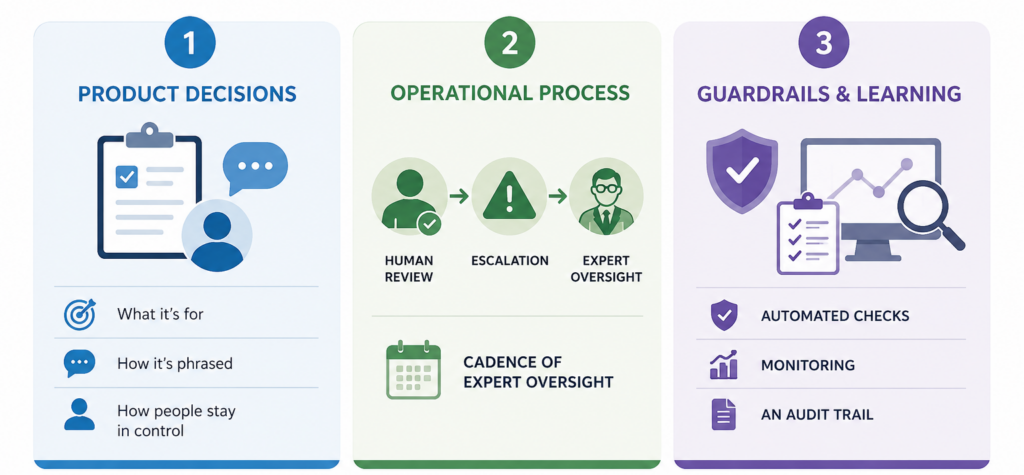
In practice, safe AI is more than just a ‘model’, it’s a product. When we view it as a product, it is easier to make deliberate product decisions for the application of the model. Decisions like, what the AI is for, how it’s presented, and where humans need to stay in control on the output. We must put sensible processes around our reviews. As well as adding automated checks and record‑keeping so we can learn and improve over time.
Inputs > AI suggestion > safety checks > human review > learning loop
The details vary by product, but the principles don’t.
Data input: Define boundaries and responsibilities
Start by being clear about boundaries. What information the AI can use, what it must ignore, how up-to-date the inputs are, and who owns data quality. This prevents false confidence and makes issues easier to investigate.
Expert context: Encode clinical intent before inference
Care quality depends on domain knowledge. You should build and maintain clear guidance on ‘what good looks like. This is in terms of terminology, standards and policies. Crucially, with named owners and a review cadence. So the AI stays aligned with your service as practice and policy evolve.
AI analysis: Require evidence, not opinions
Whatever the AI outputs, it should be available to review. Which means showing the relevant source text and including a brief explanation. You want to avoid the logic of ‘because the model says so’. It is vital that the evidence the model utilises is identifiable and interrogatable.
Automated guardrails for AI: Validate before humans see it
AI can be trained to add lightweight automated checks. These are useful for catching the obvious problems before a human sees them. For example, unsupported claims, inconsistencies or repeated items. These checks don’t need to be fancy or overly detailed, however, they do need to be reliable.
Support check: Is the suggestion grounded in the record?
Consistency check: Does anything contradict other outputs?
Noise control: Remove duplicates and low-confidence clutter.
Policy checks: Enforce a few non-negotiables your organisation cares about, including known issues for AI models like bias, fairness and hallucinations.
Human-in-the-loop: Keep clinical judgement in the driver’s seat
We must keep humans in control. You should design the experience so reviewers can quickly understand the suggestion, accept or reject it, and escalate edge cases. Then use real-world feedback to improve the system on a regular cadence.
The goal is simple, make it easy to do the right thing, and hard to do the wrong thing. The reality is simpler than you’d suspect to achieve.
Responsible AI is also a product problem
There are a number of risks in AI that are well documented. It is important to note some of the AI risks in social care don’t come from ‘the model’ alone. They come from product decisions like wording, defaults, missing context, and unclear accountability.
It is important that you address these issues with your product teams. Once these basics are set, governance becomes repeatable.
Be clear about the role of AI The model suggests, humans decide.
Design for review Make sure to show context and make disagreement easy.
Make uncertainty safe Include clear escalation paths for high-risk or unclear cases.
Be transparent Understand what the model looked at, and what it can’t do.
Governance processes you need and how to operationalise them
Governance is how you earn trust over time, and sets the standard for your guardrails for AI. It is vital to test, monitor, update safely, and keep an audit trail of your actions.
Evaluation: Agree what “good” looks like, then keep testing it!
Before you ship any new features it is crucial you test against a reference set of real cases reviewed by experts. After you ship, keep sampling and checking performance so any drift that occurs doesn’t surprise you. A good way to do this is to define a small set of ‘go/no‑go’ checks for your releases. Be explicit about data handling and access. If you can’t explain those basics, you can’t govern the system.
Change control: Make updates safe (and easy to roll back)
Treat updates like a high-stakes product release. Ensure you are doing everything thoroughly, document changes, getting the right sign-off, and make rollback a straightforward process.
Metadata and auditability: Make every finding explainable
Audit trails are essential aspects of guardrails for AI. You need to keep an audit trail so you can answer important questions and evidence your working. Questions like, ‘What did the AI see?’ ‘What did it suggest?’ and ‘What did the human decide?’.
Inputs: What record and when?
Outputs: What was suggested and why? (with supporting context!)
Decision: What the reviewer did? (and any escalation)
The roles behind responsible AI in care
Data and data security
The effectiveness of any AI system depends on the quality, relevance, and governance of the data it uses. Organisations should be able to clearly explain what data is being used, where it comes from, and how it is curated to ensure it remains accurate, current, and appropriate for the task at hand. This curation process is critical, as it provides the AI with the right context, rules, and safeguards to support decision-making in complex care environments. Rather than relying on vast amounts of unstructured information, responsible AI carefully selects data sources that reflect best practice, regulatory requirements, and the realities of delivering care.
Equally important is the security of that data. Care providers, practitioners, and the people they support place significant trust in the organisations that handle their information. AI vendors should be transparent about where their products are developed and hosted, how data is stored and processed, and the measures in place to prevent unauthorised access, misuse, or data leakage. This includes robust technical safeguards, strong governance frameworks, and ongoing monitoring to ensure sensitive information remains protected at every stage.
A basic checklist before you ship
Safe AI in social care comes from disciplined choices. Teams that design for review, keep humans in control, add sensible checks, and maintain an audit trail. With these guardrails for AI it can quickly become a practical support for care teams. One that they can trust because they can understand it without asking them to accept the findings of a ‘black box’ at face value. Below is a basic checklist for your team to utilise. This is designed as a starting point for your team and is not definitive. After all, AI models, like care communities, are at their best when they champion their unique perspectives!
Humans stay responsible: Clear review and escalation workflows
Test before release: Utilising real, expert-reviewed cases as your benchmarks
Release safely: Include simple go/no-go checks and rollback functionality
Log decisions: Record all of your inputs, outputs, and reviewer outcome
Structured process for review: Plan for ongoing testing and evalution
Keep improving: Conduct regular expert oversight and monitoring
Artificial intelligence (AI) has shifted from a niche topic in tech circles to a headline conversation across health and care over the past couple of years. What was once the preserve of data scientists and software engineers is now discussed in care home corridors, home care offices, and even over the dinner table! But while the hype is loud, the reality for social care is more nuanced, filled with both opportunity and the responsibility to get it right. Join us as we explore the reality and potential of AI in social care.
The reality of AI in social care
Much of the buzz stems from Generative AI (GenAI). Tools like ChatGPT and Microsoft Copilot that create new content like text or images. These have made AI accessible to anyone, even those with no technical background. This accessibility has sparked imagination and curiosity across the care sector. Care leaders are starting to ask, “What can AI do for us?”
However, the reality is that large-scale return on investment (ROI) for AI in social care hasn’t been fully realised yet. While the tech industry is racing ahead, the challenge for our sector is not to chase AI for its novelty. But to apply it deliberately to real business and care problems.
Two clear paths exist:
Tech-driven innovation Companies build increasingly powerful models. An exciting approach, but one that is often disconnected from on-the-ground needs. Which is incompatible with community centred care.
Problem-driven design Where we start with the care challenge and design AI tools to address it in safe, specific, and scalable ways. The best forms of which involved lived experience throughout. Which is known as keeping a ‘human in the loop’.
For obvious reasons, at Nourish we believe it’s the second path that holds real promise for social care.
Why AI can be a game changer for social care
At its best, AI offers a way to augment human work, not replace it. In social care, this means easing the administrative load, surfacing critical insights faster, and supporting preventative approaches that improve quality of life for the people we serve.
A useful way to think about this is through the ‘Triple Aim’ framework from US healthcare, which focuses on:
Improving quality and satisfaction for those receiving care
Improving health outcomes
Reducing the cost of care delivery
For UK care providers, AI can directly support these aims. For example:
Prevention of adverse outcomes AI can analyse patterns from care records to identify those at risk of falls or wound complications. Early alerts allow proactive interventions.
Efficiency in processes Instead of manually sifting through thousands of care notes, AI can flag only those needing review. Freeing your teams time to focus on direct care.
Person-led care Carers can use AI to surface relevant insights from each individual’s data. Enabling care providers to tailor care plans more effectively to the specific needs and goals of their community.
Crucially, this is not about replacing carers with algorithms. It’s about using AI in social care to lift some of the cognitive burden. So that staff can spend more time doing what only humans can. Building relationships and delivering compassionate, intuitive care.
How AI works in practice
AI depends on data, and in social care, the ongoing shift to digital systems means we now have more data than ever before. Care records, care notes, health metrics, and incident reports all hold valuable insights if we know how to extract them.
Two main AI techniques are particularly relevant:
Generative AI (GenAI) These models excel at working with large amounts of unstructured text. For example, they can be trained to identify patterns in free-text care notes, spotting trends that might otherwise go unnoticed.
Machine Learning (ML) This involves feeding structured data into a model to detect patterns and make predictions. For instance, by analysing hydration levels and health conditions a machine learning model can help predict falls risk.
The most effective approach blends these techniques with expert oversight. A concept known as supervised learning. This ensures the AI’s “understanding” is guided by the experience of clinical professionals and frontline carers. Which in turn ensures the insights it produces are safe, relevant, and trustworthy.
Why responsible AI matters
Social care deals with some of the most sensitive data possible, and the wellbeing of real people. That makes Responsible AI not just an ethical choice but a practical necessity.
Responsible AI follows core principles:
Fairness and inclusiveness Avoiding bias that could harm certain groups and propagate incorrect information.
Privacy and security Safeguarding private personal and medical data.
Transparency and accountability Ensuring decisions are traceable and explainable so every decision can be reviewed and understood.
Human oversight Staying connected to the realities of care by keeping a “human in the loop” for all decisions.
This last principle is crucial. In social care, AI should suggest, not act. That is what we mean by augmenting, rather than replacing care. A falls-risk prediction, for example, should prompt a human review and intervention. As opposed to automatically changing a care plan.
This protects against the risks of over-automation. So, providers can ensure that the irreplaceable human qualities of care, empathy, intuition, and contextual judgment, remain at the centre. This is why we build systems that are transparent and auditable. So, we understand why recommendations are given and remain accountable to them.
Practical applications on the horizon
Responsible AI opens the door to several promising use cases:
Enhanced wound management AI can identify patterns in wound care data, predict complications, and suggest preventative interventions, such as optimal dressing-change frequencies.
Quality assurance in care notes By training a model on high-quality care notes, AI can review thousands at once, flagging those that might lack necessary detail or clarity.
Early dependency detection Analysing patterns over time can help identify changes in a person’s level of independence, supporting proactive adjustments to care plans.
These examples share a common goal. Namely: moving from reactive care ‘What happened?’ to proactive and preventative care ‘Why is it happening, and how can we change the outcome?’.
Building trust in AI in social care
For AI to be embraced in social care, trust must be earned and maintained. This means:
Involving care providers and clinical experts in design.
Validating AI outputs before deployment.
Using models that can explain their reasoning.
Updating and monitoring models regularly to ensure accuracy and fairness.
Trust isn’t a one-off achievement. It’s a relationship that must be nurtured through ongoing transparency and collaboration.
The road ahead
The potential of AI in social care is undeniable. Used responsibly, it can improve outcomes, reduce costs, and allow carers to focus more on human connection. But the key word is ‘responsibly’. Rooted in human experience and shaped by the people and communities it supports.
The most effective AI in our sector will come from co-production. Solutions developed hand-in-hand with those who understand the realities of care and support. Both in terms of those who provide care and support, and those who utilise it. This ensures the technology supports the real needs of the sector. Rather than forcing the sector to adapt to the technology.
In the end, AI in social care should not be about replacing human judgment but empowering it. The goal is a future where technology enhances the compassion, skill, and dedication that define our sector. Where AI is the assistant, and people remain firmly in charge.
At UK Care Week 2025 our Director of Data & AI Sudha Regmi took to the Caring & Sharing stage to address a topic sweeping the social care sector, Artificial Intelligence. Sudha spent time laying out the Nourish approach to AI design and model development. One roted in responsible AI, co-production and transparent modelling.
Sudha draws on her extensive 15 years of experience developing AI models in a range of industries to lay out the potential applications of AI in social care. Starting with data analysis and carrying through to predictive and prescriptive applications of AI. With specific regard to the ‘Triple Aim’ of improving care quality, personal outcomes and care outcomes.
Sudha also explores the guiding aims and design principles that shape AI model’s development. She details potential risks, why responsible, transparent design is crucial and how these tie into the UK government’s responsible AI principles.
AI is a discussion taking many forms. In care and support it is vital to ensure these forms always keep the people utilising your service at the forefront of their AI design process. This can only be guaranteed through a commitment to coproduction and collaboration across health and care providers, suppliers and communities.
Nourish Partnership Programme
If you’d like to learn more about how we work with other suppliers, make sure you check out the Nourish Partnership Programme for a list of compatible technologies we integrate with. If you are an exsiting Nourish user, you can contact your Account Manager directly to learn more.
Nourish Case Studies
If you’d like to learn more about working with Nourish check out our case studies. We cover a range of care and support types including residential, home care, learning development, mental health and more. Read the case studies here.

 ArticlesStories and expert opinions on important issues in social care