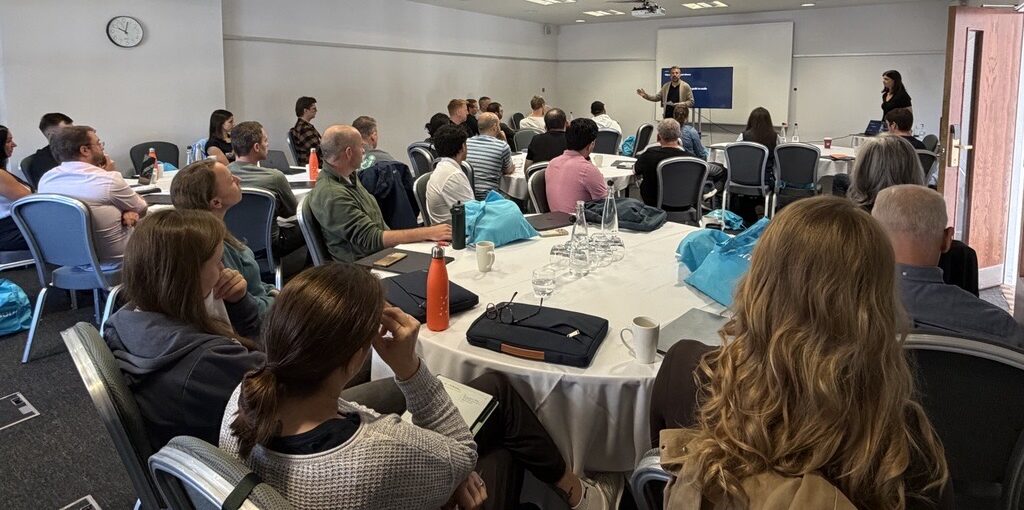
At Nourish we know the best results come from collaboration. That’s why we try to involve as many perspectives and areas of expertise as possible when building our solutions, and choosing our direction for the future. This ranges from co-producing functionality with people utilising care services to hosting departmental get togethers to explore and expand internal ideas. Our inaugral AI Lab is a prime example of the latter. Our goal was to use the AI Lab event as an examination of our AI-native culture. So we could celebrate participants internally, and better understand the varying opinions on AI application in digital care.
There were two key organisers of the event. Our Director of Data & AI Sudha Regmi, and our People & Culture Director Kate Crouch, shared their insight on the day in this blog.
Our first company wide Nourish AI Lab: Turns out it wasn’t really about the AI!
We both have a vested interest in AI, though we come at it from different angles. Sudha’s focus has been customer and product AI, Kate’s has been internal AI enablement. We’ve been working closely for a while now, bouncing ideas off each other and challenging each other’s thinking. Organising this Lab together was a natural extension of that. It wouldn’t have been the same event if only one of us had been driving it.
We set out with the intention to increase AI capability and fluency internally by having a cross functional team come together to build something real against an actual business problem.
Building something real with AI
What we got was two exciting, exhausting days. Passionate people got energised by understanding the problem, exploring what was possible, and dedicating time into building something real. There were late nights, plenty of coffee, lots of persistence, and a fair bit of figuring things out as we went.
Every single person who came to the event said they’re likely to keep building or experimenting with AI now the two days are over, and almost everyone thinks their idea deserves to go further.
Five cross functional teams, five real Nourish problems
The five key challenges we focused in on on the day were.
Turning specialist clinical knowledge into deployable digital pathways
Reimagining customer success plans
Drafting tender responses
Turning monthly win/loss data into useful insights for different teams
Taking an ambiguous customer operational problem and turning it into a solvable brief
We aimed to stay away from hypothetical case studies and toy data dressed up as a challenge. Instead, we focused on real work that people in this business deal with every week.
What made it work wasn’t really the AI enablement (although having the AI Engineering team on hand was hugely appreciated!) It was the mix of people in the room. A colleague who spent years on surgical wards found herself on a team with product managers, user experience specialists and engineers. They told us it felt like a new kind of multi-disciplinary team! One with different expertise, but the same instinct to bring it all to bear on one problem.
Developers got to sit closer to the decision-making than they normally do. Customer Success got to watch their world get solved for, instead of guessed at. As one of you put it afterwards: “What allowed it was focus. One problem, one goal, no meetings, co-location.” That mix and that focus, more than any model or tool, is what let teams go from a whiteboard sketch to something they could actually test in under two days. All while following our governance frameworks!
A key take away for social care technology from our AI Lab
That’s the thing we keep coming back to. So much of the conversation about AI is dominated by the latest model release. Or an abstract prediction about the future of work. What actually moves things forward is people who understand a problem picking up the tools already in front of them and building something useful, together.
It wasn’t seamless, it wasn’t meant to be even with less than 2 days to produce something, the demos went far beyond our expectations with some of them close to production ready. And this is key, this wasn’t meant as purely a learning exercise. We’ll be taking the strongest outputs forward and putting real resource behind turning them into things we actually use.
Thank you to everyone who put their name down, showed up, and built something in two days that didn’t exist before. We’re really proud of what came out of this one, and we’re looking forward to sharing where the ideas go next.
AI can help care teams work more consistently and spot risk earlier. However, social care is a deeply personal service that is both context-heavy and filled with risk. Which means we need strong governance and clear guardrails for AI. The English social care regulator, the Care Quality Commission, recently released their guideline for the safe and effective application of AI in care settings. In this blog we explore how to design AI for social care that exemplifies these standards so it can best elevate the quality of care and support available.
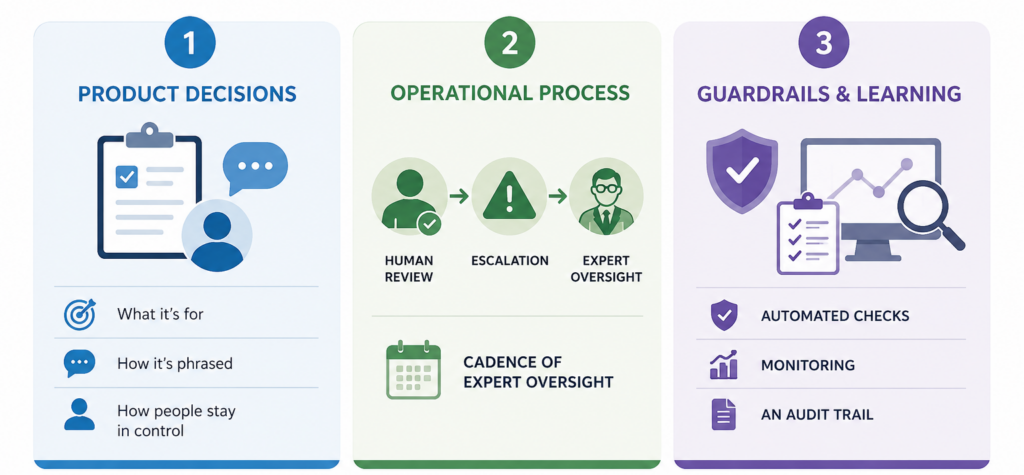
In practice, safe AI is more than just a ‘model’, it’s a product. When we view it as a product, it is easier to make deliberate product decisions for the application of the model. Decisions like, what the AI is for, how it’s presented, and where humans need to stay in control on the output. We must put sensible processes around our reviews. As well as adding automated checks and record‑keeping so we can learn and improve over time.
Inputs > AI suggestion > safety checks > human review > learning loop
The details vary by product, but the principles don’t.
Data input: Define boundaries and responsibilities
Start by being clear about boundaries. What information the AI can use, what it must ignore, how up-to-date the inputs are, and who owns data quality. This prevents false confidence and makes issues easier to investigate.
Expert context: Encode clinical intent before inference
Care quality depends on domain knowledge. You should build and maintain clear guidance on ‘what good looks like. This is in terms of terminology, standards and policies. Crucially, with named owners and a review cadence. So the AI stays aligned with your service as practice and policy evolve.
AI analysis: Require evidence, not opinions
Whatever the AI outputs, it should be available to review. Which means showing the relevant source text and including a brief explanation. You want to avoid the logic of ‘because the model says so’. It is vital that the evidence the model utilises is identifiable and interrogatable.
Automated guardrails for AI: Validate before humans see it
AI can be trained to add lightweight automated checks. These are useful for catching the obvious problems before a human sees them. For example, unsupported claims, inconsistencies or repeated items. These checks don’t need to be fancy or overly detailed, however, they do need to be reliable.
Support check: Is the suggestion grounded in the record?
Consistency check: Does anything contradict other outputs?
Noise control: Remove duplicates and low-confidence clutter.
Policy checks: Enforce a few non-negotiables your organisation cares about, including known issues for AI models like bias, fairness and hallucinations.
Human-in-the-loop: Keep clinical judgement in the driver’s seat
We must keep humans in control. You should design the experience so reviewers can quickly understand the suggestion, accept or reject it, and escalate edge cases. Then use real-world feedback to improve the system on a regular cadence.
The goal is simple, make it easy to do the right thing, and hard to do the wrong thing. The reality is simpler than you’d suspect to achieve.
Responsible AI is also a product problem
There are a number of risks in AI that are well documented. It is important to not, some of the AI risks in social care don’t come from ‘the model’ alone. They come from product decisions like wording, defaults, missing context, and unclear accountability.
It is important that you address these issues with your product teams. Once these basics are set, governance becomes repeatable.
Be clear about the role of AI The model suggests, humans decide.
Design for review Make sure to show context and make disagreement easy.
Make uncertainty safe Include clear escalation paths for high-risk or unclear cases.
Be transparent Understand what the model looked at, and what it can’t do.
Governance processes you need and how to operationalise them
Governance is how you earn trust over time, and sets the standard for your guardrails for AI. It is vital to test, monitor, update safely, and keep an audit trail of your actions.
Evaluation: Agree what “good” looks like, then keep testing it!
Before you ship any new features it is crucial you test against a reference set of real cases reviewed by experts. After you ship, keep sampling and checking performance so any drift that occurs doesn’t surprise you. A good way to do this is to define a small set of ‘go/no‑go’ checks for your releases. Be explicit about data handling and access. If you can’t explain those basics, you can’t govern the system.
Change control: Make updates safe (and easy to roll back)
Treat updates like a high-stakes product release. Ensure you are doing everything thoroughly, document changes, getting the right sign-off, and make rollback a straightforward process.
Metadata and auditability: Make every finding explainable
Audit trails are essential aspects of guardrails for AI. You need to keep an audit trail so you can answer important questions and evidence your working. Questions like, ‘What did the AI see?’ ‘What did it suggest?’ and ‘What did the human decide?’.
Inputs: What record and when?
Outputs: What was suggested and why? (with supporting context!)
Decision: What the reviewer did? (and any escalation)
The roles behind responsible AI in care
Data and data security
The effectiveness of any AI system depends on the quality, relevance, and governance of the data it uses. Organisations should be able to clearly explain what data is being used, where it comes from, and how it is curated to ensure it remains accurate, current, and appropriate for the task at hand. This curation process is critical, as it provides the AI with the right context, rules, and safeguards to support decision-making in complex care environments. Rather than relying on vast amounts of unstructured information, responsible AI carefully selects data sources that reflect best practice, regulatory requirements, and the realities of delivering care.
Equally important is the security of that data. Care providers, practitioners, and the people they support place significant trust in the organisations that handle their information. AI vendors should be transparent about where their products are developed and hosted, how data is stored and processed, and the measures in place to prevent unauthorised access, misuse, or data leakage. This includes robust technical safeguards, strong governance frameworks, and ongoing monitoring to ensure sensitive information remains protected at every stage.
A basic checklist before you ship
Safe AI in social care comes from disciplined choices. Teams that design for review, keep humans in control, add sensible checks, and maintain an audit trail. With these guardrails for AI it can quickly become a practical support for care teams. One that they can trust because they can understand it without asking them to accept the findings of a ‘black box’ at face value. Below is a basic checklist for your team to utilise. This is designed as a starting point for your team and is not definitive. After all, AI models, like care communities, are at their best when they champion their unique perspectives!
Humans stay responsible: Clear review and escalation workflows
Test before release: Utilising real, expert-reviewed cases as your benchmarks
Release safely: Include simple go/no-go checks and rollback functionality
Log decisions: Record all of your inputs, outputs, and reviewer outcome
Structured process for review: Plan for ongoing testing and evalution
Keep improving: Conduct regular expert oversight and monitoring
We hosted our AI and Data Conference at Bletchley Park this January. The historic backdrop inspired us to look to the future potential of AI and data in social care. Over the course of the day we heard for customer panels, product managers and Nourish users on and off stage. It was an inspiring event that energised all attendees for the year ahead!
AI & Data Conference recap video
Our day in Bletchley Park
The day started once everyone had settled in to the historic venue. Our Chief Product Officer Matthew Stewart opened the proceedings with an overview of our position on AI, our ambitions for care intelligence, and the odd season joke here and there. This was followed by our Director of AI & Data Sudha Regmi detailing the Nourish view into Analytics, Insights and Nourish AI.
We had two panels with customers, one on either side of lunch. The first panel, led by our Chief Customer Officer Paul Barnes was focussed on Nourish Analytics. Paul was joined by Emma Lindblom, Head of Quality Improvement at MHA, Gareth Williams, Flexible Workforce Manager at Brandon Trust and Benjamin Winfield the Product Owner Lead for Quality and Business Systems at Lifeways Group. They built upon Sudha’s point about moving descriptive to prescriptive with Analytics and the journey of embedding the functionality in an organisation.
Mark Gray, Nourish AI Product Lead, hosted our second panel. It focussed on our new AI platform Nourish Confidence and it’s co-production journey. Our Clinical and Safety Lead Carrie Taylor and Emma Brazier, Business Analyst for Sanctuary Supported Living joined him on the panel. They discussed our journey to finding the right application for AI. As well as how we can change the ways of approaching audits to drive continuous improvement for people with support in addition to how we can bring together different functionality to provide holistic, truly person centred care and support.
Over lunch attendees were treated to a tour of the venue. Getting to take in the history and groundbreaking work that took place in the birthplace of AI.
Big discussions and future plans
The best discussions happened in between all of the sessions. We took the opportunity to display many of the new platforms and features of the Nourish ecosystem. Talking to people from across the wide range of care and support services represented by our attendees is always the highlight of these events. We closed on a discussion of our roadmap. And our Chief Technology Officer Jamie Hibbard making a special announcement about our AI Labs!
Nourish Customer Speakers at AI and Data Conference
We are incredibly grateful to everyone who joined us in Bletchley Park. Some of our attendees even jumped on camera with us to share their experiences and perspectives. You can see these Nourish users in the video, and look out for longer versions of their interviews on our social media!
Ozayr Patel, Development Manager, Lancashire County Council Steve Bowler, Digital Transformation and Implementation Manager, Greensleeves Care Sian Smail, Health and Social Care Data Analyst, Care Dorset UK Elliot Goodwin, Area Director, Consensus Support Services Alicia Ingham, Operational System Improvement Lead, MHA Jay Harper, Head of Communications and Projects, Rehability UK Jane Hayden, Head of Technology, Treloar’s Ross Watson, Senior Product Manager, HC-One Gemma Pitman-McGrath, Clinical Development Nurse, Barchester Steve Daniels, Operational Change Lead, iVolve Care & Support
Beyond the AI & Data Conference
We are so excited for the future of AI & data in health, care and support technology. Find out why on our Nourish AI page.
Anthropic recently published a new constitution for ‘Claude’, their Gen AI model. The AI is designed for natural conversation, complex reasoning, coding, analysis, and content creation. Anthropic was founded with the aim of creating AI with a focus on safety and ethics. An ambition shared in the health and care sectors, where safety is a paramount concern given the huge responsibility communities entrust in their care and support providers. Throughout their technology’s iterations Anthropic repeatedly look to connect their functionality to human values. This approach resonates with us at Nourish, where we firmly root our AI models in lived experience by always keeping a ‘human in the loop’ throughout the design process. We believe principals are essential for applied AI, as we continue to search for the most impactful and effective applications of AI in health and care technology.
Our director of Data and AI, Sudha Regmi, saw several parallels between Claude’s new constitution. Here are her three key takeaways from the recent announcement.
“When choosing how to apply AI models to modern challenges, there is no predictable answer. We must, to borrow a technique from social care, review our impact, continuously improve and remain connected to lived experience.”
Sudha Regmi
Director of Data & AI
Principles are more important than rules
“When you’re raising kids, you can’t just hand them a list of rules and hope it covers every weird eventuality life throws at them,” explained Sudha. “You try to teach values and principles, then trust they’ll generalise when it matters.”
Anthropic is basically saying the same thing. No, not that all GenAI is inherently attention seeking and impulse driven. (That’s just a good portion of the user base). They are saying, don’t just tell the model what to do, teach it why with context. This gives the model the ability to generalise across novel situations. With ‘rules’ in place, GenAI can become confused by edge cases. With ‘principals’ the model is better designed to understand context and infer the correct decision.
We need to move past the ‘it was trained on the internet so every model is the same’ myth for Applied AI
“This is an understandable but misleading hangover from early AI scepticism. Pretraining is very important for AI models, but is not the be all and end all, especially for applied AI. Post-training is also very important. Along with feedback loops, policy layers and product choices. When choosing how to apply AI models to modern challenges, there is no predictable answer. We must, to borrow a technique from social care, review our impact, continuously improve and remain connected to lived experience.”
No two experiences are exactly the same. You can see this in the real world with “the same base model” behaving differently depending on where you use it. Put the same prompt into different models and look at the output. These differences express themselves across both different models and different iterations. For example, think about the difference in output when you have Copilot (in gpt5 mode), ChatGPT or OpenAI GPT models doing the same tasks via APIs. Or the differences when using Claude Sonnet in Claude Code vs Claude Cursor.
There are vast differences in models that share similar origin stories. Applied AI will continue to develop in a huge variety of fields. We must be able to more deeply understand the context of the model, before we can effectively teach the model the context of its application.
This isn’t academic, it has an impact on your product!
“The constitution is explicit about priority order: safe → ethical → compliant → helpful. It includes ‘hard constraints’ for especially high-stakes work. It validates that the process of building AI is just as important as the product.”
The process of building applied AI is crucial. Principles are deliberate, and they can’t just live on a slide deck. They must be represented in your approach to AI design, including:
Incentivising the right kind of outputs for the context Health and care are not vibes-based domains. Decision carry a huge amount of weight and privacy. Context is essential for understanding both best practice and the reality of the responsibility.
Human-in-the-loop validation with clinical experts Lived experience remains the alpha and the omega for technology design. Without human input into the design process, AI can never be considered responsibly designed.
Tight feedback loops with our customers to pressure-test what “good” looks like in practice That’s what breeds confidence in applied AI. Not reverential ‘this is what the model said to do’. Not black box decision makers. But results driven by a combination of principles, process and validation.
Continuing on from Claude’s constitution
If you’re building with AI right now or even thinking about adopting AI tools, we’d recommend reading the constitution. Even if you disagree with parts of it. It’s a useful window into how one lab is translating “alignment” into something operational.
If you want to know more about Nourish Care’s approach to applied AI for health, care and support, click here.
Artificial intelligence (AI) has shifted from a niche topic in tech circles to a headline conversation across health and care over the past couple of years. What was once the preserve of data scientists and software engineers is now discussed in care home corridors, home care offices, and even over the dinner table! But while the hype is loud, the reality for social care is more nuanced, filled with both opportunity and the responsibility to get it right. Join us as we explore the reality and potential of AI in social care.
The reality of AI in social care
Much of the buzz stems from Generative AI (GenAI). Tools like ChatGPT and Microsoft Copilot that create new content like text or images. These have made AI accessible to anyone, even those with no technical background. This accessibility has sparked imagination and curiosity across the care sector. Care leaders are starting to ask, “What can AI do for us?”
However, the reality is that large-scale return on investment (ROI) for AI in social care hasn’t been fully realised yet. While the tech industry is racing ahead, the challenge for our sector is not to chase AI for its novelty. But to apply it deliberately to real business and care problems.
Two clear paths exist:
Tech-driven innovation Companies build increasingly powerful models. An exciting approach, but one that is often disconnected from on-the-ground needs. Which is incompatible with community centred care.
Problem-driven design Where we start with the care challenge and design AI tools to address it in safe, specific, and scalable ways. The best forms of which involved lived experience throughout. Which is known as keeping a ‘human in the loop’.
For obvious reasons, at Nourish we believe it’s the second path that holds real promise for social care.
Why AI can be a game changer for social care
At its best, AI offers a way to augment human work, not replace it. In social care, this means easing the administrative load, surfacing critical insights faster, and supporting preventative approaches that improve quality of life for the people we serve.
A useful way to think about this is through the ‘Triple Aim’ framework from US healthcare, which focuses on:
Improving quality and satisfaction for those receiving care
Improving health outcomes
Reducing the cost of care delivery
For UK care providers, AI can directly support these aims. For example:
Prevention of adverse outcomes AI can analyse patterns from care records to identify those at risk of falls or wound complications. Early alerts allow proactive interventions.
Efficiency in processes Instead of manually sifting through thousands of care notes, AI can flag only those needing review. Freeing your teams time to focus on direct care.
Person-led care Carers can use AI to surface relevant insights from each individual’s data. Enabling care providers to tailor care plans more effectively to the specific needs and goals of their community.
Crucially, this is not about replacing carers with algorithms. It’s about using AI in social care to lift some of the cognitive burden. So that staff can spend more time doing what only humans can. Building relationships and delivering compassionate, intuitive care.
How AI works in practice
AI depends on data, and in social care, the ongoing shift to digital systems means we now have more data than ever before. Care records, care notes, health metrics, and incident reports all hold valuable insights if we know how to extract them.
Two main AI techniques are particularly relevant:
Generative AI (GenAI) These models excel at working with large amounts of unstructured text. For example, they can be trained to identify patterns in free-text care notes, spotting trends that might otherwise go unnoticed.
Machine Learning (ML) This involves feeding structured data into a model to detect patterns and make predictions. For instance, by analysing hydration levels and health conditions a machine learning model can help predict falls risk.
The most effective approach blends these techniques with expert oversight. A concept known as supervised learning. This ensures the AI’s “understanding” is guided by the experience of clinical professionals and frontline carers. Which in turn ensures the insights it produces are safe, relevant, and trustworthy.
Why responsible AI matters
Social care deals with some of the most sensitive data possible, and the wellbeing of real people. That makes Responsible AI not just an ethical choice but a practical necessity.
Responsible AI follows core principles:
Fairness and inclusiveness Avoiding bias that could harm certain groups and propagate incorrect information.
Privacy and security Safeguarding private personal and medical data.
Transparency and accountability Ensuring decisions are traceable and explainable so every decision can be reviewed and understood.
Human oversight Staying connected to the realities of care by keeping a “human in the loop” for all decisions.
This last principle is crucial. In social care, AI should suggest, not act. That is what we mean by augmenting, rather than replacing care. A falls-risk prediction, for example, should prompt a human review and intervention. As opposed to automatically changing a care plan.
This protects against the risks of over-automation. So, providers can ensure that the irreplaceable human qualities of care, empathy, intuition, and contextual judgment, remain at the centre. This is why we build systems that are transparent and auditable. So, we understand why recommendations are given and remain accountable to them.
Practical applications on the horizon
Responsible AI opens the door to several promising use cases:
Enhanced wound management AI can identify patterns in wound care data, predict complications, and suggest preventative interventions, such as optimal dressing-change frequencies.
Quality assurance in care notes By training a model on high-quality care notes, AI can review thousands at once, flagging those that might lack necessary detail or clarity.
Early dependency detection Analysing patterns over time can help identify changes in a person’s level of independence, supporting proactive adjustments to care plans.
These examples share a common goal. Namely: moving from reactive care ‘What happened?’ to proactive and preventative care ‘Why is it happening, and how can we change the outcome?’.
Building trust in AI in social care
For AI to be embraced in social care, trust must be earned and maintained. This means:
Involving care providers and clinical experts in design.
Validating AI outputs before deployment.
Using models that can explain their reasoning.
Updating and monitoring models regularly to ensure accuracy and fairness.
Trust isn’t a one-off achievement. It’s a relationship that must be nurtured through ongoing transparency and collaboration.
The road ahead
The potential of AI in social care is undeniable. Used responsibly, it can improve outcomes, reduce costs, and allow carers to focus more on human connection. But the key word is ‘responsibly’. Rooted in human experience and shaped by the people and communities it supports.
The most effective AI in our sector will come from co-production. Solutions developed hand-in-hand with those who understand the realities of care and support. Both in terms of those who provide care and support, and those who utilise it. This ensures the technology supports the real needs of the sector. Rather than forcing the sector to adapt to the technology.
In the end, AI in social care should not be about replacing human judgment but empowering it. The goal is a future where technology enhances the compassion, skill, and dedication that define our sector. Where AI is the assistant, and people remain firmly in charge.

 ArticlesStories and expert opinions on important issues in social care