Digital technology has rooted itself in social care over the past few years. There are a lot of options for care providers looking for digital social care software, ranging in size, shape and functionality. 80% of providers have some form of digital social care records, with more digitising every month. This shows the adaptability of the care sector as it utilises new tools to address long standing challenges. However, with these new tools come new challenges too, and many providers are starting to realise not just the power of using digital technology, but the potential of using the right digital technology.
Finding the right technology is like finding the right people. You must know who you are and what you want, to get what your service needs. Are you looking for cutting edge innovations and reporting to transform your processes? Do you want to shape your system to your community and improve how you engage with the people you support’s circle of care? Is reliability, in both technology and people, your focus? Does your system adhere to the 14 DSCR standards?
Your requirements list may include all of these and so much more, your current digital system may meet some of your requirements but might fall down in other areas. It’s important to review whether your current system is working for your service and if there might be a better system out there that truly enhances the important work you do. In this blog we cover why it might be time for you to switch to Nourish.
At the forefront
Social care is in a state of change. Departed from the old standards but still developing its true form. This can breed uncertainty as much as excitement for digital social care software users. That is why Nourish are always engaging with decision makers, researchers and care sector leaders to make sure our user’s voices are heard. We have consistently led the way for digital innovations in care at both the technical and legislative level. Nourish were the first digital social care records system to join the NHS England Assured Solutions List, as we wanted to make it as easy as possible for care providers to go digital. We are fully compliant with all 14 DSCR standards released by Digitising Social Care last year. Additionally, we are the first supplier to attain level 3 conformance against the Professional Records Standards Body’s (PRSB) standards for personalised care and support planning.
We lead the discussion about future developments of digital social care through our role with Care Software Providers Association (CASPA). While taking steps to innovate the relationships between existing software suppliers in social care with our Partnership Programme. We accept it is not possible to know for sure what form the future will take. But it is well within our powers to prepare for it.
Digestible data
One of the major benefits of increased digital system application in social care comes from how we use our data. Every interaction generates data, each appointment, activity and report. Many care providers are sitting on a wealth of information with no way to spend it on the people they support. Nourish’s robust reporting suite empowers users to take control of their data. We give you the tools to identify trends, respond accordingly and review the success of these changes. With more information at their fingertips coordinators and carers can respond effectively to the needs of the people drawing upon your service, in a safe, well led manner.
We include several prebuilt dashboards within our system, to help our users get what they need. These dashboards can become a cornerstone or a starting off point for your team’s application of data. We want to demystify digital and help everyone in your organisation use a digital system to improve human care.
Attention behind the curtain
Care is human and so are we. That might seem like a strange thing for a software supplier to proclaim. If there’s one thing we’ve learned from years of developing technology, it’s that people drive everything. That’s why people remain central to the Nourish experience. With us, there is always a human on hand to help. From your onboarding stages, through to our comprehensive Customer Success Managers and support teams. We maintain a high standard for user experience and support because we appreciate the people that drive social care. For all the impressive and effective technical advancements we make, there are some things that will always require a personal touch.
Wrap around digital social care software
The people who utilise your service require a personal touch too. We know that no two care providers are the same. Geography, demography, psychography, the number of varying factors is off the charts! That’s why Nourish is built to be customisable. You can match your system to your service and ensure it delivers exactly what you need. This customisability empowers your team to provide truly person-centred care, with more information and less effort than ever before! There’s no need to force your community to fit into a box off the shelf. Our team will work with you during your onboarding to make sure Nourish is set up exactly how you want it to be. We can even help introduce you to new features and functionality that align with your service!
Family matters
Introductions can be tricky things in fairness. Especially when it comes to those we love. With the increase in digital social care solutions there has been an increase in accessibility. Naturally, interested family members and friends are curious to learn more about the care their loved one receives. Family portals offer a great opportunity to share this insight. However, it can also be a challenge. With Nourish you stay in control. Welcome people into the world of care you provide, while still maintaining control over what they can and can’t see. There is no ‘one size fits all’ solution in care, but thanks to our customisability you can easily find the size that fits your community.
Safe and secure
Of course, you only want the people with invitations to have access to your system. Security is paramount to us here at Nourish. With 83 million rostered appointments in last 12 months in home care and 10 million residential data records updated on care plans every day in Nourish we know how crucial security is and we are dedicated to protecting the confidentiality, integrity and availability of your system.
Nourish backs up data continuously to a cloud-based system. We do not use onsite data stores and all our cloud-provided solutions are backed up automatically and built into our disaster recovery plan and testing. This ensures the highest standard of security for the data of our users and the people they support.
Now that’s a fine looking system, why doesn’t mine look like that?
Digital social care systems have come a long way in the past few years. So have the people using them. Digital literacy is at an all-time high, and care providers are experienced enough to ask software suppliers detailed questions they wouldn’t have thought of previously. These are important questions to finding the right system for your service, and ones we’d be delighted to answer if you contact us.
With so many options available to care providers today, is it time for you to branch out?
Many of our team members have had first-hand experience working in health, care and support settings. We’ve walked in your shoes, faced the challenges you face, and celebrated the victories of providing quality care. This wealth of experience continues to shape Nourish Care platforms into what they are today. Our experience gives us unparalleled insight into the sector and allows us to deliver software solutions that truly makes a difference.
The care experience in the Nourish team ranges from carers and activity coordinators to registered nurses and registered managers. The importance of having care experience is essential throughout our team and has shaped our focus with the introduction of roles such as Clinical Lead and Safety Officer. We also have team members with nursing and care experience including Quality Assurance. In addition, our Customer Success teams truly put the impact and outcomes for people supported by care at the forefront of everything we do.
Nourish origins
Nourish founder and CEO, Nuno Almeida spent time working in care services before the idea of Nourish had been formed. He saw care teams struggling to find time to fit their handwritten notes into their already tremendously busy day and how sometimes issues that needed to be reported slipped the net because there was no opportunity to record those concerns in the moment. He saw how many notes needed to be written to record every care interaction and to prepare for the always-looming CQC inspection.
Nourish began with the mission to give those receiving care a voice and input on the care they receive and to give the team supporting them time to deliver truly person-centred care.
“I volunteered with a care home and I was just a Portuguese chap that had a good enough English, able to come on in and help us with baking competitions on a Wednesday for example. When I started spending time in care homes, it became very obvious that care workers were writing a hell of a lot of notes. It is clear that carers genuinely have caring as a vocation but aren’t always confident writing notes and this can really remove motivation or joy out of the job they do. That’s where the idea of Nourish came from.” Nuno Almeida, Nourish founder and CEO.
Understanding what’s important
There are things you learn while working in care that can only come from that environment. From operational sustainability challenges like how much it costs to use agency carers and how the shifts run. To risk reduction for people supported such as statistics around falls. Crucially, how knowing essential information about a person receiving care immediately can change how a person experiences care. The Nourish team started out their careers in the sector in a variety of different care services and job roles. Which means as a team we have great coverage of the sector. We can and regularly use our experiences to enhance our abilities at Nourish.
“I have only ever worked in care and cannot imagine working in another field. I worked as both a care coordinator and a registered manager. Both job roles gave me an insight into the pain points that care providers experience in their day to day. As well as how digital platforms can support you in providing person-centred, safe, quality care.
“I draw upon my experience providing care everyday when supporting my users as a Customer Success Manager. Whether that’s training them on how to fully utilise the rostering and scheduling or supporting managers to run reports from the system in line with their compliance. If you have worked in care you will know the feeling of joy you get at the end of the day knowing you have made a difference in someone’s life. I still get that feeling now knowing I am helping my customers provide an impactful, safe and person-centred service.” – Jessica Atkinson, 10 years’ experience in care, Senior Customer Success Manager at Nourish.
We know the importance of the little things. We know the difference between feeding someone lunch and assisting someone to eat their lunch. The crucial difference between giving someone a choice regarding the care they receive and assigning care based on an assumption. We know the importance of personalising care notes over the same text being copy and pasted. We know because we have experienced it first-hand.
“Each time I deliver a Nourish training session, people will want to know how a certain feature relates to their sector specifically. By being able to personally draw on a large number of previous experiences across a multitude of care and support sectors, this helps the people being trained to use Nourish more effectively as I ‘get’ what they are needing. This creates a mutual trust pretty quickly and those being trained know that they will get what they need to put Nourish into action in their services.” Jason Hengler, 29 years experience in care, Trainer and Project Manager at Nourish.
The joy the care sector brings
Working in the health and social care sector is a skill that regularly goes underappreciated. The narrative surrounding the sector is often negative and the selfless hard work that goes on largely goes ignored. Many of our team have worked in care and know that it is so much more than its reputation. Health and social care is a rewarding career with a clear career path. It relies on emotional intelligence, the ability to build relationships and spot signs of change. Our experience in care has given us the ability to communicate effectively with and about the people you support. We cherish the first-hand experience in the feeling that comes with delivering great person-centred care.
Nourish exists to ensure that care teams get the opportunity to provide the best care they can by reducing administrative burdens, enhancing communication across the whole team and giving carers back time to spend on person-centred care.
“As a Community Team Manager previously, my journey has been a blend of compassion and adaptation to the digital age. Transferable skills and experiences have enabled me to have a deep understanding and empathy to the needs of my customers and this has ensured that I am able to suit their needs as a Customer Success Manager in a more effective and speedy manner. Working for Nourish has allowed me to tap into my experience within the home care environment. As I have experience as a care coordinator, a carer and a manager, I am able to adapt and tailor my training sessions and support to ensure that the content is relevant for the individual.” Katie Loader, 5 years’ experience in care, Senior Customer Success Manager at Nourish.
Nourish’s personal approach
Because so many of us have worked in care, we know that each service is truly unique in its approach and working ways. That is why Nourish is unique and a leader in the digital social care sector. Nourish platforms are shaped by lived experience, from the people who work at nourish, to the communtieis utilising it, and everyone in between. Our solutions are customisable and can be tailored to your service’s needs to ensure your care service retains what is unique about it.
“Having been involved in a family run care home from a young age gave me a respect and understanding for the sector like no other. Knowing the pressures, the pain points and the sheer variation of the day to day really helps when thinking ‘is this new feature in the platform going to work in practice‘. The team will often hear me repeating the same thing ‘benefit vs burden’ and that comes from understanding the sector. Here at Nourish, we don’t just create a product, we genuinely aim to improve the lives of the manager, the carer and most of all the person receiving support.” Dan Hollingworth, 10 years experience in care, Product Owner at Nourish.
“My experience of working in care homes helps me to understand the daily struggles carers face. That everything is documented correctly. That everyone has had their care delivered properly. That medication has been administered at the correct times. That tasks have been completed, all within a particular timescale for multiple clients with different needs. I try to use that experience every day to make sure we deliver a quality product. One that alleviates the stresses that come with being a carer so they can offer great support for their clients.” Curtis Cridland, 5 years experience in care, Senior Quality Assurance Engineer at Nourish.
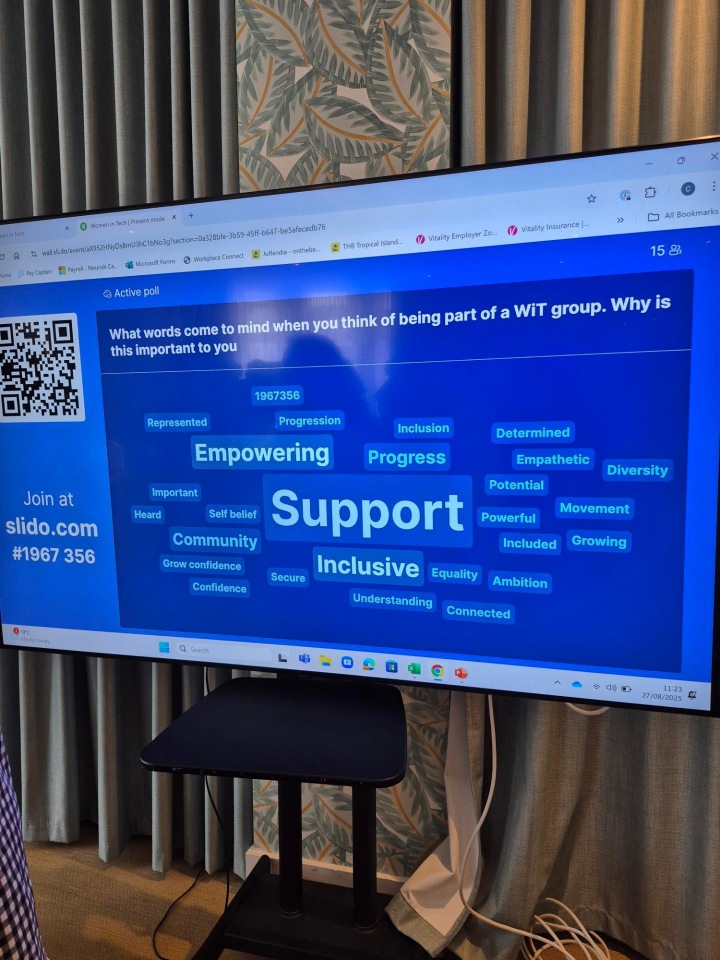
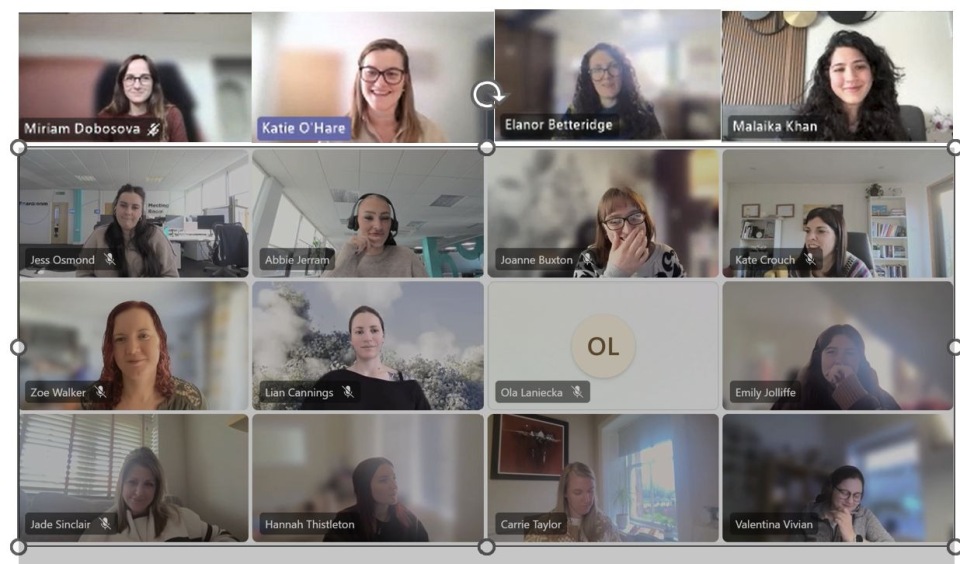
Nourish Care hosts an internal ‘Women in Tech’ group to bring together women from across our departments to share experiences, insights and inspiration. Our Director of People and Culture, Kate Crouch, reflects on the theme for this year’s International Women’s Day ‘Give to Gain’ in the context of technology and social care.
Every year on International Women’s Day, I’m reminded of the progress made toward gender equality and the work still ahead of us. This year, the theme “Give to Gain” offers a powerful reflection point, not just for society, but for us as a community working in technology and in a sector built fundamentally on compassion: social care.
In social care, giving is at the core of everything. It’s the heartbeat of the work our users do every day, supporting individuals, families, and communities. And, it’s a value that resonates deeply with how we support one another inside our organisation too. Which is why it’s reflected in several of the key pillars of our Culture Code.
Collective Effort: We help each other out because we know that when one person wins, we all win.
Making a Difference: We go above and beyond because we remember who we serve. We know the difference we’re making to the lives of those in care.
Every Person Counts: We genuinely care about all the individuals and groups of people in the Nourish circle and across our sector more broadly.
‘Give to Gain’ in social care technology
‘Give to Gain’ reflects the truth that generously sharing knowledge, time, encouragement, and opportunity creates returns far beyond what we invest.
This certainly rings true in the tech space. Especially tech in a sector traditionally powered by women yet underrepresented in technical roles! I find giving takes many forms, including:
Sharing lived experience to help others navigate their careers
Mentoring and championing future women leaders
Opening doors for opportunities, stretch projects, and visibility
Amplifying a woman’s voice in rooms where she isn’t present
Supporting inclusive practices that reflect the values of social care: dignity, compassion, and empowerment
These actions help women not only enter tech but thrive in it. And in return, we gain stronger teams, deeper innovation, and more human centred technology aligned with what the care sector needs.
Women in Tech
Our internal Women in Tech group was created to bring women in our organisation together for exactly these reasons. Like the care sector itself, Nourish is built on the belief that people flourish when they feel supported, included, and connected.
Within our Nourish Women in Tech group, we’ve started to benefit from:
A dedicated space for connection, insight, solidarity, and lived experience
Building relationships across departments and seniority levels
A safe space for learning where questions are welcomed
Nourish thrives not just because of what we gain individually, but because of what we choose to give: time, encouragement, advocacy, empathy, and support.
Our Women in Tech group is also an important part of the culture we want to be part of. At Nourish this is incredibly important to us and having a group that really embodies the our values means we continue to create a ripple effect that supports the whole organisation, not just women. An environment that empowers people to contribute openly, values varied viewpoints, and doesn’t shy away from confronting bias.
While we celebrate progress, it’s important to acknowledge a simple truth: we are not there yet.
Moving forward
Women, especially women in tech, continue to face challenges including unequal representation, slower career progression, societal expectations, and persistent barriers to leadership roles. In the care sector too, while women overwhelmingly make up the frontline workforce, they remain underrepresented in the decision making roles shaping the future of the industry.
Achieving gender equality requires continued commitment to:
Breaking down structural barriers
Challenging biases, both conscious and unconscious
Creating equitable career pathways
Ensuring women have the sponsorship, not just mentorship, they need to progress
Designing workplaces that celebrate difference rather than expect conformity
Progress isn’t guaranteed, it is created through consistent action. And every one of us plays a part.
The Care sector is fundamentally human. Technology here isn’t just about systems or software; it’s about enabling better outcomes for people. When women bring their experience, empathy, and leadership into tech roles, especially in care, innovation becomes more inclusive, more thoughtful, and more effective.
Strengthening women’s voices ultimately strengthens the sector we operate in, that is the core of the ‘Gain to Give’ message. We are the rising tide, and together we can lift the whole care sector up.
Care Show Birmingham 2025 was a highlight of this year’s social care calendar. And we had plenty to highlight at Nourish. With two floors and three new products to share we were very excited for the opening bell on Wednesday morning.
Over two days at the NEC Birmingham, the event brought together hundreds of care professionals, thought leaders, suppliers and change-makers. The energy was electric, the conversations rich, and we captured highlights in our recap video for you. A special shout out to Heather Taylor, National Digital Projects Lead for the National Care Forum for joining us and sharing their experience!
From sessions on workforce development to digital transformation, regulation, and assistive technology, Care Show 2025 offered a snapshot of where the sector is going. And, crucially, how we can shape it together.
We even took to the stage ourselves!
On stage at Care Show Birmingham 2025
Our Chief Product Officer, Matthew Stewart, joined our Product Manager, Paul Skuse on stage. They talked us through the development and application of Nourish Transparency. Highlighting how we can utilise existing information to move beyond dependency.
Our Home Care Product Lead, Paul Antonioni, shared how Nourish Better Care at Home’s new app is designed for the future. Paul detailed how we champion a mobile first, person led approach for care at home.
We discussed Nourish Safety’s ability to support turning incidents into action. With Product Lead, Mark Gray, Clinical Safety Lead, Carrie Taylor. And featuring special guest Lyndsay Atkinson Swales, Director of Operations and Quality, St Anne’s Community Services.
Come see us at future events
If you’d like to chat in person, we’d love to see you! Check out where we’ll be this November.
Communication defines relationships. Whether personal or professional, the success of our relationships rests on our ability to communicate effectively with one another. In care this is understood clearly. Care providers go to incredible lengths to better understand, empathise and involve the people utilising support in their service. The same approach can be applied to your relationship with the regulator of your social care compliance. Regardless of the regulator of your service, talking to people to better understand the care you provide will be a central part of their inspection process. Preparing the people in your organisation for these conversations is crucial to taking control of your compliance rating. We explore how you can work on your team’s ability to communicate clearly with your regulator in this blog. Starting with your care and support team, before moving to managers and leaders, and finally central operations and quality assurance. Each of these conversations will vary in approach and focus but are unified by their ability to impact your inspection rating.
Care & support team
Your care and support teams are your direct connection to your community. They interact every day with the people drawing upon your support. This gives them an intimate knowledge of the needs of your community, the processes and philosophy of your service as it is applied in action. A role that requires them to be excellent communicators. So how can you best help carers prepare for a conversation with an inspector?
Confidence is king.
Confidence in the care they provided, confidence in the information recorded, confidence in their approach and pride in the results. Inspectors want to see the care you provide, but they also want to ensure your carers know how and why they are providing it. Carers with a more formative role in the care development will naturally be more confident when describing it. Building this confidence over time for other carers is a matter of engaging with your team. Ask practice questions to help them familiarise themselves with the process and become more comfortable.
Confidence with their care management system is also crucial. The right system is an accessible resource for carers to evidence their care and demonstrate their understanding. This is especially true for agency staff. Accessible records offer a level of familiarity with your service that agency staff can draw upon. Creating a continuity of care that underpins quality social care compliance.
Managers & leaders
It’s important to remember the inspector’s perspective. Your rating is more than the evidence you provide; it is also dependent on the inspector’s ability to comprehend it. A clear and easily navigable software system can help make this information simple to access and follow for inspectors. You can offer them their own login to explore. Or have a carer guide them through the system, highlighting the work they do, their understanding and efficiency. This rings especially true for agency staff. Agency staff using accessible care management systems find it easier to fit into the unique structure of your service.
“The Care Inspectorate in Scotland love Nourish. The feedback we’ve had from the last two inspections highlighted how much oversight our managers have. And how much we can share with them. We had an inspection in Edinburgh recently and they were blown away by the fact we could give them a bespoke login that just showed them the information they wanted on the people they were funding. We can do it for local authorities as well. It’s really good.”
Richard Maddison
Quality Manager, Care Concern Group
A care management system offers you the ability to record your care accurately. This data is central to your social care compliance. When managers can draw specific and detailed reports they can take more confidence in their conversations. Not just in demonstrating the service they provided, but, crucially, pointing to the outcomes of your care.
Ownership breeds confidence, just ask anyone with a BMW. When your care managers and leaders feel like the owners and drivers of the care they provide, they will be in the best position to talk about its quality. Pride might be a sin, but it is deadly effective in inspection interviews. When the work you do helps people live their best lives it is natural to take pride in it. Anything else would be unfaithful to the spirit of care. Managers that can harness this pride, and evidence improved outcomes over time, are well positioned for any inspection.
Central operations & quality assurance
For central operations and quality assurance team members you want to be able to show the big picture. This means being able to communicate your approach to oversight and how feedback cycles through your service in a responsive manner. Showing your processes backs up the evidence provided on a more specific level by your carers and managers. Reinforcing the quality of your care.
Social care compliance is linked to your policies and procedures. You need to be able to present them and demonstrate how you implement them. Again, this comes back to confidence and ownership as outlined earlier. Care management software can also support you. Simplifying the recording, reviewing and reporting of your policies and procedures.
Additionally, quality care management systems include an ‘audit trail’. This records every change that occurs on your system. Each assessment, each care plan update and all the clicks in between. This gives you a clearly evidencable history of activity on your platform. Painting a picture in real time of the journey of your care, the reality of your policies and the effort of your team.
Confidence, conversation and social care compliance
Relationships are hard, ask anyone whose partner owns a BMW. Communication is the bridge that we build between each other. And whether you are building a bridge between people utilising your service or the people inspecting it, its strength will be defined by the clarity of your communication. This is true to the point that being able to demonstrate the effectiveness of your approach to internal communication in your service is an indicator of quality care.
But, and it’s a big but, effective communication is not telling people what they want to hear. It is telling them what they need to know. This includes pushing back when you feel misrepresented. You are the expert in your service. Set a standard of open, clear communication with your inspector and you will have the confidence to speak the truth to power. Clarity is rarely achieved easily. With confidence in your service, and the evidence to prove your points, clarity is the result that will earn you the rating you deserve.
Professional development in social care is a fundamental building block for the future of our sector. Skills for Care’s ‘Workforce Strategy for Adult Social Care’ details several benefits of investing in care eLearning and training. These range from driving quality care to improving your ability to recruit and retain care workers. Fundamentally, the impact of professional development in social care reverberates through every aspect of your service. At Nourish Care we appreciate that there are many white papers, plans and strategies for improving social care. The challenge lies in finding the time, energy and platform to pursue them.
Our care eLearning partnership
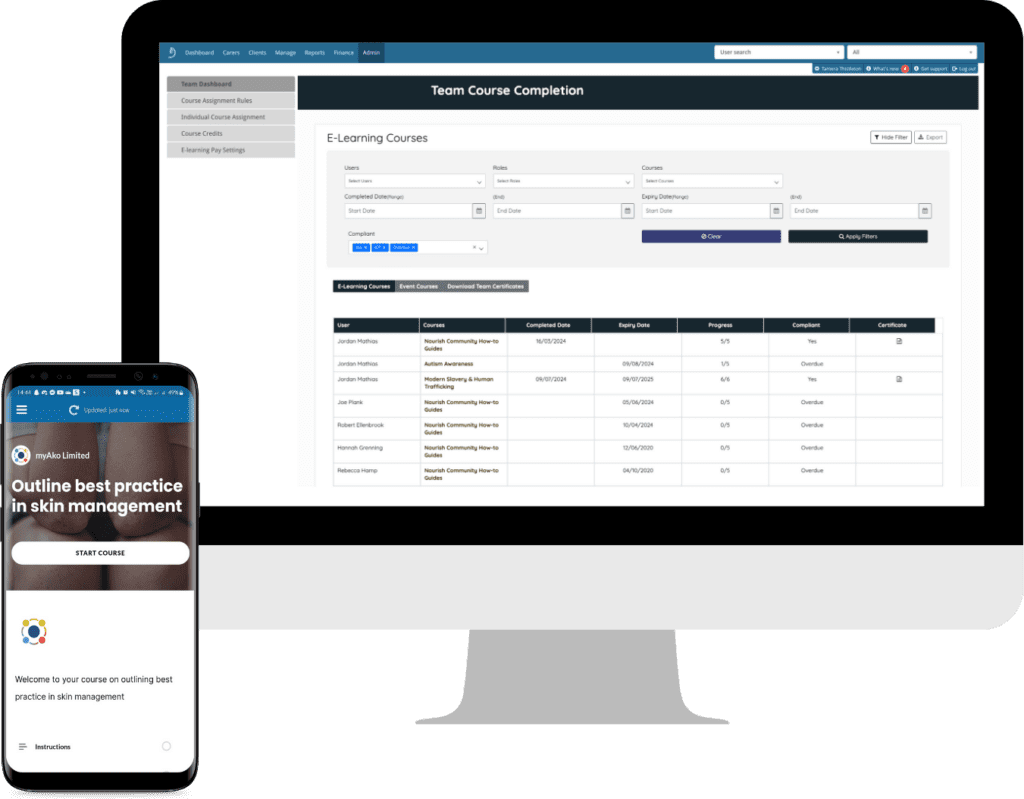
That’s why we are so excited to announce the latest member of our Nourish Partnership Programme, MyAko. MyAko are a Skills for Care and CPD accredited eLearning provider. We’ve partnered with them to deliver an all-in-one digital learning solution for home care agencies. Our platform links directly to the Nourish Rostering app. Enabling easy access for your staff and offering a streamlined way to manage training compliance. With over 100 thousand active users MyAko’s comprehensive library of courses covers a range of topics. Their platform has over 60 courses dedicated to professional development in social care, including Care Certificate, Safeguarding Adults and Children, and Moving and Handling People. Crucially, they are committed to continually developing and adding to the courses they provide.
“We share Nourish’s passion for enhancing and professionalising health and social care by incorporating state-of-the-art technology and skills development. Our aim is to equip care workers with the best practices they need, especially at crucial moments, to deliver outstanding care. I am genuinely excited to work with a forward-thinking company that is dedicated to providing world-class solutions and excellent service, driving excellence in care delivery.”
Kevin Ashley
Founder & CEO, MyAko
Getting started with our new care eLearning integration
We linked our home care rostering platform directly with MyAko to streamline your experience. This means you will have full access to a range of MyAko’s care eLearning features directly through Nourish. Shape the development of your teams by assigning and tracking courses. You can keep an eye on progress and monitor compliance throughout the duration of these courses for more organisational oversight as well as downloading certificates upon course completion. This gives you a throughline for recording, reviewing and reporting your teams training. So not only can you provide professional development in social care, you can evidence it as well.
Signing up is as straightforward. Simply head over to the Admin eLearning section and click the “Sign Up” button to get started. Once activated you can set up Course Assignment Rules to establish mandatory courses for your team, based on your existing regions or job titles. It is also possible to set up unique training per person when it’s needed. You’ll find this option in the Individual Course Assignment section.
You pay for courses with course credits, which can be bought directly through the platform. The cost of courses ranges from 1-3 credits depending on the topic. This gives you the flexibility to pick and pay for courses suited to your company’s needs. There is a report available for your course credit purchases as well to help you keep track of your costs. You can also establish pay settings to ensure that your teams are compensated for their learning time.
Courses for professional development in social care
MyAko boasts a range of courses covering a variety of relevant topics for social care. Including professional skills, safeguarding and clinical best practise. With over 60 courses to choose from you can shape your training to the needs of your community. Here are some examples.
Care certificate
The Care Certificate is an agreed set of standards that define the knowledge, skills and behaviours expected of specific job roles in the health and social care sectors. Developed jointly by Skills for Care, Health Education England and Skills for Health because of the need for official certificates in our sector. The Care Certificate consists of the 15 minimum standards people considered ‘new to care’ need to cover which should form part of a robust induction programme. MyAko’s course covers the 15 standards within the Care Certificate and checks the knowledge of the learner through the end-of-module assessments.
Staff appraisals
MyAko offers courses that are directly tied to care skills, as well as ones that help develop other professional skills necessary to provide outstanding care. The appraisals course aims to provide the learner with general knowledge surrounding staff appraisal skills and the role it plays within the workplace. This course is a combination of both theoretical knowledge and interactive activities, designed to help the candidate learn, and practice. This develops crucial leadership and management skills for your staff and helps provide a pathway for further development.
Duty of candour
Duty of Candour is a common expectation from all health and care providers. It requires care providers and managers to act in an open and transparent way with people receiving care or treatment from them. While this seems straightforward from the outside all carers can appreciate the delicate touch it requires. This course shows learners that promoting a culture of openness is a prerequisite to improving customer safety and the quality of our health and social care systems. Upon completion of the course, your team will be able to classify Duty of Candour and recognise best practice. Another key point is how you can distinguish between various levels of harm and associated actions and additionally which of these are notifiable safety incidents.
Training matrix
We recently released a new training matrix report. This report is available to all Nourish home care users, regardless of if you sign up for the new care eLearning courses. This exportable report provides an overview of your team’s training status, as a result making it easier to track who’s completed their training and who may need a refresher. For more information about your new report, log in to your Nourish Rostering system and check out the Training Matrix Report guide found in the Help Centre. With this new report we aim to make managing your team’s learning and development more efficient and straightforward.
The future of care eLearning
Training is a crucial part of developing the future of care. It is vital we engage with professional development in social care to continue to take charge of our own sector. Empowered care teams deliver higher quality care with more job satisfaction. Investing in care eLearning can help with the recruitment and retention of your workforce as well. With Nourish and MyAko you can lay the foundations for your future success.
Community is at the heart of quality care. At Nourish Care we are indebted to our community of users, one that spans a range of care types and locations in the UK. We know that the best results come from clear communication and committed collaboration. Our users frequently provide the inspiration and insight that drives the development of our platform. So, it is only natural that we are always looking for opportunities to connect directly with our users. This summer we welcomed over 70 of our valued users to The Gherkin in London for our customer conference. The conference took place over an afternoon and featured idea sharing, our latest product road map and some inspirational talks from guests and Nourish leaders.
Welcome Drinks at The Gherkin
The best place to start is always at the beginning, and there’s no better beginning than a drinks reception. The conference kicked off at lunchtime with a selection of drinks and ‘mocktails’ provided by the lovely Gherkin staff. It takes two separate lifts to get to the iconic floor 39, known locally as ‘The Helix’. The magnificent view of London’s skyline slowly started to fill with chatter as the attendees made their way up. The sound of conversation quickly filled the floor and provided a wonderful soundtrack to the view.
Keynote Speaker: Dr Waheed Arian
Once everyone had proceeded upstairs to ‘The Iris’, the famous glass dome at the top of the Gherkin for lunch, a delectable chicken ballotine followed by a lemon and ginger posset, it was time for the presentations. The first speaker of the afternoon was the incredible Dr Waheed Arian. The doctor, humanitarian, and innovator shared his story with the audience and his perspective on ‘the business of compassion’. Everyone in the room shared his vision of providing health and care support through passion. He detailed the sense of pride and joy we all receive from working with people, and implored attendees not to fall victim to overt self-criticism at our perceived failures. The last question, ‘what does care mean to you?’ carried with it an implicit instruction, ‘Do not lose sight of what you mean to others’.
An Insight into Nourish
We all took a break following Dr Arian’s evocative presentation. Upon returning it was time for the Nourish representatives to take to the stage.
First up was Nourish founder Nuno Almeida. Nuno took us through a brief history of the past few years, the pandemic, supply chain issues around the world and reassured us all with the fact that quite frankly, ‘there is no return to normal’. This stark and honest reflection underpinned Nuno’s entire talk. In a world of constant change (did you know there’s 70 elections happening around the world this year?) we turn to the people we trust for support. This rings true in technology as it does in care. Reiterating Nourish’s focus on building our team to be the right people for the challenge ahead, Nuno painted a picture of a bright, and collaborative future.
The Future of Product Design
Next up was our new Chief Product Officer Matthew Stewart to discuss our new product agenda. Matthew brings a wealth of experience to his role and demonstrated how this is already benefiting Nourish. The talk focused on the key areas of our new product agenda, and how we will be moving forward. Crucially, the session ended with an open Q&A to promote collaboration and idea sharing. Several attendees shared their perspectives and helped further focus the product agenda as we move forward. Co-production is a vital tool for the future development of care, and this is especially true for the development of care technology.
Nourish Partnership Programme
The development of care technology does not have to be a lonely road, as we learned in the last session of our conference. Our Director of Partnerships and Business Engagement Denise Tack detailed the motivation and success of our emerging Nourish Partnership Programme. She was joined on stage by Camascope’s Customer Director Saurabh Shah and PainChek’s Head of Business Development Tandeep Gill. They explained exactly why our Partnership Programme is ‘not just an API hub’ but a collaborative undertaking. One built on a foundation of philosophical and technological alignment. We look for partners whose background, motivation and vision match ours at Nourish as well as their technology.
A Great Inaugural Event in The Gherkin
It was a great day for sharing visions all round. We are deeply grateful to everyone who made the trip to The Gherkin to join us for the day. It was a fantastic time overlooking London Town, learning about our users’ worlds and sharing our plans with them. We can’t wait for the next one, and plans are already in place to hold it in a more northern location so we can engage with our community across the UK.
The day was a reminder of the size, breadth and impact of the community we are a part of, and the joy and purpose we feel working with you.
Personalised care plans are a rising tide, one that elevates the care experience for everyone in your community. Starting with your care teams.
Digital care plans are the best way to ensure your care team provides person-led, community centred support to those they care for.
Each individual is different. Therefore a one-size-fits-all approach doesn’t always work. Especially when you care for people with very different needs.
When it comes to working with personalised plans on paper, things can be quite tricky. With care teams looking after many different people at the same time, a lot of carers’ time is spent looking at care plans, writing up notes and analysing information by hand. Understandably, this becomes very time-consuming. Ultimately taking away from the time they could spend with those they support.
Working digitally transforms the way care teams work with personalised care plans
As personalised plans become far easier to create, manage and analyse online, they can also be shared easily with members of a care team. In this case everyone can see the information they need at the click of a button.
This results in people receiving a much more personal and bespoke level of care. Ensuring care teams always work with a person-led approach. There are many benefits to personalised care plans that empower teams to provide a greater level of care.
A team of carers who enjoy their job is so crucial for quality care When care teams are happy, this shines through in their delivery of care. Here are just a few ways personalised plans empower care teams working digitally.
1. Improved team efficiency
The most common benefit for care teams using personalised plans is increased efficiency.
Having each care plan easily accessible at the touch of a button saves carers a huge amount of time. No more looking through stacks of paper and spending hours at the end of a shift writing up notes. Improving time management, and increasing care note accuracy. It also means there’s no confusion or questioning when shifts change. When you handover to the next carer they have all the information they need readily available. Informed carers ensure your community gets everything they need in a timely fashion.
The Nourish system has a handover feature which allows carers to quickly review previous notes. Informing them of what a previous team member did previously. So that change overs are seamless and carers provide consistent care at all times.
2. Increased confidence in your role
Empower your carers with personal plans for each individual they support accessible at the touch of a button. Securing their confidence in their role.
Personalised plans provide in-depth information about a person and their needs. Including everything from their allergies and medication history to their likes and dislikes. Having this information to hand allows carers to get to know the people they support. And in having this deeper understanding of their needs, carers can feel confident they are providing the safest form of care for individuals.
The Nourish system has the ability to log notes and send direct messages to other members of staff. Strong communication is crucial for quality care. This makes it easy for care teams to communicate with each other and support each other in their daily tasks.
3. More time with those you support
Those who work in care do so because they want to help and make a difference in people’s lives. But time ia always a factor. When there are mountains of paperwork to do at the end of a shift it can detract from your care quality. Carers feel like they could be doing more if it wasn’t for all the admin that comes with the job.
Personalised plans that are created digitally allow carers to spend less time on admin and paperwork, and more time doing what they do best, caring.
“I’d say we’ve saved about 50 to 60% of our time across the board.”
Spending quality time with those in care is good for both the person receiving and giving the support.
The majority of carers’ job satisfaction comes from being able to make genuine human connections and really make a difference to those they care for. Admin is often seen as a necessary evil of the job, something to be endured at the end of the day. A digital way of working can cut down this admin time immensely, and involve your community in the process!
4. Provide greater autonomy to care teams
Autonomy is the key to a smooth-running team. Personalised plans can help provide greater clarity on individual needs, without any uncertainty.
With a comprehensive care plan, handover notes and direct messaging available within the Nourish system, carers no longer need to search high and low for specific information about a person. A personal care plan will have all the important details of what that person needs. So that the carer on duty can get on with their work efficiently and effectively.
The Nourish system has a comprehensive care plan and personalised timeline that gives carers an extensive overview of a person’s biography, care needs, medication, emergency information and more.
5. Boost workplace morale
Having easy digital access to personalised care plans empowers care teams in the workplace with a better understanding of what is required of them in their role. Working digitally eliminates a lot of the uncertainty and groups all information together in one central location. Which provides greater structure and direction for care teams.
With a clearer view of the needs of each person under their care, their work becomes easier and they feel more motivated to go above and beyond. Additionally, combining this with a more streamlined system that everyone can access drastically cuts down admin time and empowers teams to provide more person-led, community-centred care. There’s no doubt that a digital way of working is going to boost morale in the workplace.
With the structure and efficiency of a digital personalised plan, teams can put all their effort into providing outstanding care for everyone.
Bespoke digital care plans for care teams
A smarter way to care. We’ve worked with over 1,000 care services and organisations to deliver truly person-led, care plans that transform the way care teams manage and support those they support.
For more information on how the Nourish system can help your care service begin to empower your care teams, get in touch and book a demo today.
Many of us use some kind of technology to monitor our health and well-being. We’ve got fitness trackers, smart watches, sleep trackers, fluid logs, gym apps and so much more. We input our data and track our progress so we can see where and how we can make changes to improve our health. And just as it can improve our health, data and analytics can improve your care management too!
With this in mind, the same concept is now being applied in the care sector. Care teams are now able to use a digital system to record notes and assist with daily care. Moving away from a paper-based system comes with a whole host of benefits, one of which is the huge amount of data that can be analysed, which has great potential to improve the way care and support is provided.
In order to look at ways in which care can be improved, measurable data is needed. Not only will this help to spot any initial areas for improvement, but the continuous monitoring of data allows you to accurately measure the effects of any changes made. A data-driven approach to care can really help care teams to better understand those they support, and feel confident they are providing the safest daily care to each individual.
Fears surrounding big data
Although the idea of using data analysis is supposed to instill confidence in carers, it is understandable that many people still have their reservations about this, mainly surrounding the accuracy of said data, and where data protection comes into the equation. But when it comes to the digital vs paper debate, it is clear that paper recording poses a far greater risk for inaccuracy and inconsistencies in patient information.
We are already starting to see technology being implemented within the health and social care sectors. The NHS is slowly starting to work on digitalisation of patient records, and electronic care planning is now becoming the norm across many care homes in the UK. Now that the care sector is rapidly adopting a digital way of working, data analytics is the next step in evolving and enhancing the way we care. But how exactly can data and analytics improve your care management?
Spotting trends in those you support
One of the main benefits of analysing data is to be able to spot trends. This could be anything from eating habits to sleeping patterns, and these trends may vary between care providers.
What this allows carers to do is look at the bigger picture. Did someone refuse their dinner or their medication one night? If so, why did they? Who was on shift that evening? When looking at the bigger picture you can start to see what’s missing or what’s changed and ask the necessary questions to get to the bottom of it.
With paper recording, it can be a little trickier to keep up to date with the bigger picture and see things clearly, meaning things can get missed. While it may sound extreme, spotting someone’s decline in appetite could be the difference between life or death, as this could be the first sign of an underlying condition that could otherwise go unnoticed.
Creating continuity of care
Having data recorded electronically makes it far easier to run reports, and gain insight into individual’s needs. This type of data recording and reporting is proactive and allows you to share insight and information with your care team and other healthcare providers in a safe and efficient way.
With data reports readily available to view, this is a far more accurate way of sending and receiving up to date information, ensuring that everyone is getting the right level of care they require.
Creates a transparent care environment
When there is clear communication among care teams, you are better equipped to support those in your care. Going digital has its benefits in ensuring everyone is on the same page, but the analysis of data takes this one step further.
By providing everyone with the facts and figures in a clear and concise way, these insights will empower carers to be the best they can be. With reports and data readily available, this means everyone can have clarity around the type of care an individual needs and what is being done to support them, and family members can be kept in the loop so they have peace of mind their loved ones are in good hands.
Transparency is key when it comes to evidencing care for CQC purposes. Data analysis better equips you to provide the best quality care as well as have all the necessary information readily available for inspectors when you have an audit.
The future of data and analytics in a post Covid-19 world
This year, the care sector has faced many challenges. The Covid-19 pandemic swept across the globe and sadly became one of the leading causes of deaths within care. Understanding something like this virus can become a lot easier when we’re able to analyse the facts and the figures. Care homes who were successful in preventing an outbreak within their organisation were monitoring things extremely closely. Symptoms, incubation periods, and patient-staff interactions were all recorded and able to be analysed to track and prevent outbreaks from sweeping through their care service.
Data and analytics is quickly going to become a must within the care sector in a post-pandemic world. The Goverment have already invested £600 billion into an Infection Control Fund for care homes, and using that funding for digital transformation could help so many care services become better prepared in the future. Not only does technology make it far easier to breakdown and understand data, but using a digital device to share information with staff, families and other healthcare services is far safer as it reduces contact between one another. Staff will be able to work more efficiently when they can all access a centralised system remotely, and it’ll be easier to log and track who has been where and when which will ultimately help prevent the spread of the virus.
How electronic care planning can help
Moving towards a digital way of working has a number of advantages, and now is the time for care services who are still using paper records to make the switch.Collating and using big data allows care teams to become more aware and vigilant of the risks to those they support, understand those risks, and implement solutions. At Nourish, we want to encourage data analysis to help care organisations provide better care, which is why our electronic care planning system can also be upgraded with an analytics tool that can help spot trends and patterns to better equip you in supporting those in your care.
We now also have a Covid-19 Tracker built into our platform, so you can track the virus more closely and understand how it is affecting your care service. To find out more about how Nourish can help you provide better care, book a demo with us today.
Sleep disturbances can come from many different sources but those related to illness need extra care and consideration. No matter the condition, a foundation built on healthy sleep habits can help. Sleep hygiene, the term used to describe any personal habits and behaviours that affect sleep, ranges from the conditions of the sleep environment to food choices. The Sleep Institute have put together a list of healthy sleep habits and how you can use them for you and the person for whom you care.
Developing Healthy Sleep Habits
There are many illnesses and conditions that can interfere with how the brain releases sleep hormones. It’s most noticeable with neurological conditions like Alzheimer’s and other forms of dementia. However, conditions that limit eyesight also experience abnormal sleep cycles due to changes in how the brain receives light signals. Yet other conditions like diabetes and arthritis may face sleep problems due to chronic pain. You’ll have to consider the condition and unique circumstances as you’re deciding how to implement better sleep habits.
Predictable Sleep Schedule
The human brain craves predictability as it’s designed to adjust the sleep cycle according to your preferred schedule. Keeping a consistent bedtime helps the brain recognize when to begin the release of sleep hormones. The more predictable you can be the more readily your body responds.
Create a Simple Bedtime Routine
Routine creates familiarity and reduces disorientation. It also helps signal the brain that it’s time to start the sleep cycle. Try to complete any difficult or upsetting tasks earlier in the day so that bedtime can be relaxing for everyone involved.
Some people, especially those who suffer from chronic pain, benefit from relaxation activities like meditation in their bedtime routine. Meditation reduces the anticipation of pain and, consequently, the perception of it as well. It also reduces stress by helping the mind focus on the present moment rather than past or future stress-causing events.
Keep the Bedroom Familiar and Comfortable
A bedroom that’s familiar with each item in its place can bring the kind of comfort that reduces evening irritability. A supportive sleep environment should also be dark and quiet. Be careful with electronics that may have blinking lights. These devices, like a TV or smartphone, may have a screen that emits a bright blue light that suppresses sleep hormones. In general, they’re best left out of the bedroom. Anything that overstimulates the sense from images and colors to passing cars should also be removed or blocked out.
Make the Bedroom Safe
Illness or medications may cause hallucinations or fitful sleep, making some people prone to falling out of bed. Guardrails are a good option that will protect the person for whom you care and give you peace of mind. Guardrails can also prevent knocking over any necessary nighttime medical equipment.
Increase Exposure to Natural Light
Natural light regulates the sleep cycle by suppressing sleep hormones during the day. As natural light fades in the evening, those sleep hormones start to trickle out until they’re at full power come bedtime. It’s essential to get enough sunlight so the body functions as designed, which makes a walk outside a good form of exercise and a simple way to improve sleep.
If dimming eyesight or mobility that limits outdoor activity is an issue, exposure to natural light through normal means may not be adequate. Bright light therapy, which uses specially designed light bulbs to simulate sunlight, can be used to increase light exposure and regulate the sleep cycle as well.
Conclusion
Everyone needs and deserves a good night’s rest. As you incorporate healthy sleep habits into your life and the life of the person for whom you care, you’ll both get the rest you need. With better sleep comes the physical, mental, and emotional health that allows you to live a fulfilling life while providing high-quality care.

 ArticlesStories and expert opinions on important issues in social care